第12回 World Glaucoma Congress (WGC) は 2027年4月20日~23日に Kyoto, Japan で開催されます。World Glaucoma Association が主催し、Japanese Glaucoma Society が共催する本会議は、眼科医、視覚科学者、関連医療専門職、ならびに業界関係者を含む世界の緑内障コミュニティを一堂に集めます。イベントでは科学セッション、基調講演、シンポジウム、コース、ウェットラボ、展示会が行われます。
第12回 World Glaucoma Congress (WGC) は 2027年4月20日~23日に Kyoto, Japan で開催されます。World Glaucoma Association が主催し、Japanese Glaucoma Society が共催する本会議は、眼科医、視覚科学者、関連医療専門職、ならびに業界関係者を含む世界の緑内障コミュニティを一堂に集めます。イベントでは科学セッション、基調講演、シンポジウム、コース、ウェットラボ、展示会が行われます。
Why visit
World Glaucoma Congress は緑内障コミュニティにとっての世界最高峰の国際集会です。参加者は最新の科学的進展、進化する技術、そして緑内障ケアにおける先進的な臨床アプローチにアクセスできます。プログラムには基調講演、シンポジウム、コース、ウェットラボ、抄録発表が含まれ、国際的な専門家との学習・ネットワーキング・協働のための豊富な機会を提供します。
Why exhibit
第12回 World Glaucoma Congress は、業界パートナーに対して、緑内障専門医、眼科医、眼科従事者など世界中のオーディエンスに自社のブランドや製品を披露するユニークなプラットフォームを提供します。展示スペース、企業サテライトセッション、ブランディングオプションなどの機会を通じて、出展者は主要な意思決定者と繋がり、最新のイノベーションを発表し、緑内障ケア分野で持続的なパートナーシップを築くことができます。本会議には世界中から数千人の専門家が集まり、比類のないネットワーキングおよび事業開発の可能性を提供します。
Attendees, exhibitors & solutions
Who this event is for
Visitor profile
Typical attendee groups you can expect to meet.
眼科医
緑内障専門医
視覚科学者
関連医療専門職
検眼士
研究者
ヘルスケア業界の担当者
医学生および研修医
Exhibitor profile
Main supplier and exhibitor segments present at the show.
製薬会社
医療機器メーカー
診断機器メーカー
手術器具サプライヤー
眼科テクノロジー企業
ビジョンケアブランド
ヘルスケアIT企業
研究機関
Product categories
Key solution areas showcased across the event.
Glaucoma diagnostic equipment and tools
Surgical instruments for glaucoma procedures
Pharmaceuticals for glaucoma treatment
Patient management software for ophthalmology practices
This agenda is still being finalised. Check the official agenda for the latest sessions.
Confirmed outcomes from the previous show
Last edition results
Last edition
2025 · Athens
estimate
Visitors
5,000
Impact
The World Glaucoma Congress is where the global glaucoma community comes together to exchange science, advance clinical practice, and collectively shape the future of glaucoma care. Organized by the World Glaucoma Association and co-hosted by the Japanese Glaucoma Society, WGC 2027 will welcome ophthalmologists, vision scientists, allied health professionals, and industry partners from around the world. The World Glaucoma Congress serves as a pivotal platform for sharing the latest research and innovations.
Audience quality
Visitors typically include Ophthalmologists specializing in glaucoma, Vision scientists conducting research in ocular health, Allied health professionals involved in glaucoma care, Industry partners offering innovative solutions for glaucoma treatment. Dates and Venue: The 12th World Glaucoma Congress runs from April 20-23, 2027, at the Kyoto International Conference Centre in Kyoto, Japan. Scale and Focus: This congress gathers the global glaucoma community to discuss advancements in clinical practice.
Exhibitor outcomes
Exhibitors will have the opportunity to showcase their products and services to a targeted audience of healthcare professionals, enhancing visibility and fostering business relationships within the glaucoma community. Buyer Authority: Attendees include ophthalmologists, vision scientists, and industry professionals with significant influence in glaucoma care. The World Glaucoma Congress serves as a pivotal platform for sharing the latest research and innovations in glaucoma.
Intelligence
Market context
Kyoto, Kansai region, Japan — a major Asia-Pacific hub for ophthalmic research, clinical practice and medical-device distribution
Why it matters
Attending World Glaucoma Congress on 2027-04-20 to 2027-04-23 in Kyoto lets buyers and specifiers benchmark suppliers, see live demonstrations, and compress months of vendor meetings into one focused trade visit — worthwhile when your category roadmap aligns with the official exhibitor profile.
Industry trends
Key trends shaping this market and its wider industry.
01
AI-assisted glaucoma diagnosis
Artificial intelligence is increasingly applied to optic nerve imaging and visual field analysis to flag progressive glaucoma earlier.
02
Minimally invasive glaucoma surgery (MIGS)
MIGS procedures use smaller incisions and specialised devices to lower intraocular pressure with faster recovery than traditional surgery.
03
Hands-on surgical training
Wetlabs and skill-transfer sessions let specialists practise techniques on model eyes under expert supervision.
04
Ageing populations and disease burden
Rising life expectancy continues to expand the number of people living with glaucoma worldwide.
Global ophthalmology and glaucoma congress circuit
Book Kyoto hotels and confirm exhibition or wetlab slots 8–12 weeks ahead; peer ophthalmology congresses cluster in the same calendar year, so map travel between them early.
Ophthalmic clinicians, researchers and device suppliers plan the World Glaucoma Congress alongside other international ophthalmology meetings to compare products, clinical data and service coverage across Europe, the Americas and Asia-Pacific.
Pre-show
Confirm WGC-2027 registration, reserve Kyoto hotels before cherry blossom season demand peaks, and schedule exhibitor meetings and wetlab places.
Show week
Attend plenary and subspecialty sessions, hands-on wetlabs and the exhibition hall; follow up with suppliers, collaborators and society representatives.
Peer events are established international ophthalmology gatherings; confirm dates and venues on each organiser website before booking travel.
Plan your trip
Travel & logistics
Local currencyJPY
5arrival airports near the venue
Arrival airports
Gateways with convenient access to the event and venue.
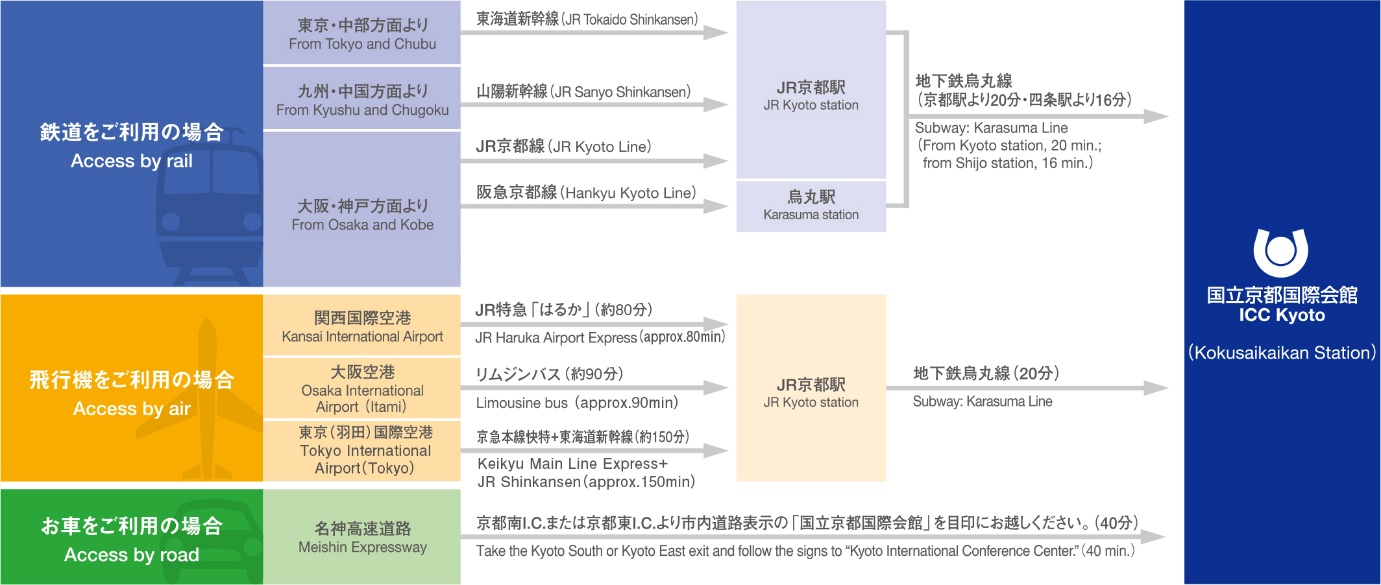
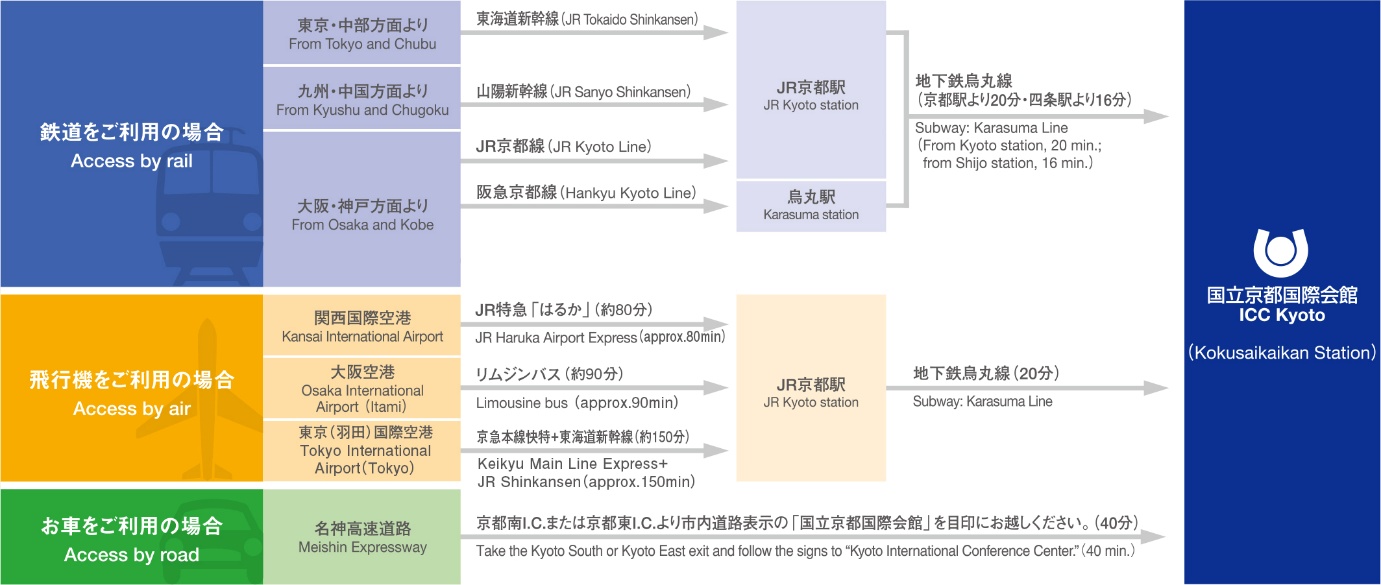
~100 km south-west of the Kyoto International Conference Centre1 hr 45 min–2 hr by road; 80 min by JR Express Haruka to Kyoto Station, then about 20 min on the Karasuma subway to Kokusaikaikan
Kyoto's principal international gateway with the widest long-haul and Asian route network. Haruka limited express runs roughly every 30 minutes; IC cards and reserved seats available.
~55 km south-west of the venue1 hr 15 min–1 hr 30 min by road; airport limousine bus to Kyoto Station in about 55 min, then 20 min by subway
Convenient for domestic connections from Tokyo, Sapporo and Fukuoka. Smaller terminal, fast transfers, and the Kyoto limousine bus drops at Kyoto Station Hachijo exit.
~510 km east of the venueAbout 2 hr 15 min by Tokaido Shinkansen from Tokyo Station to Kyoto Station, plus 20 min by subway to the venue
Long-haul alternative with the broadest global route network; the rail connection makes an arrival through Tokyo entirely workable for delegates combining the congress with a wider Japan trip.
Book flights to KIX (Kyoto) when possible for the shortest transfer to the venue.
Hotel tiers
A range of accommodation options near the venue and across key areas.
Get around the city with these convenient transport options.
airport train
Estimated costapprox. JPY 3,000-3,600 single
Best forKansai International Airport (KIX) to Kyoto Station on the Express Haruka limited express
Takes about 75-80 minutes; seat reservations and IC cards available.
subway and bus
Estimated costapprox. JPY 220-260 per ride; day passes from around JPY 700
Best forKyoto city subway, JR and bus network
Buses, subway and JR lines connect hotels, Kyoto Station and the venue; IC cards work across operators.
taxi
Estimated costapprox. JPY 6,000-12,000 from KIX; city trips JPY 1,000-3,000
Best forKansai International Airport (KIX) to Kyoto International Conference Centre
Metered and reliable; hotel desks can book.
taxi
Estimated costJPY 6,000–12,000 taxi to the venue district
Best forOsaka International Airport (Itami) (ITM) to Kyoto International Conference Centre
1 hr 15 min–1 hr 30 min by road; airport limousine bus to Kyoto Station in about 55 min, then 20 min by subway; Convenient for domestic connections from Tokyo, Sapporo and Fukuoka. Smaller terminal, fast transfers, and the Kyoto limousine bus drops at Kyoto Station Hachijo exit.
taxi
Estimated costJPY 6,000–12,000 taxi to the venue district
Best forKobe Airport (UKB) to Kyoto International Conference Centre
1 hr 30 min by road; Port Liner to Shin-Kobe in 18 min, then Shinkansen to Kyoto in about 30 min; Compact domestic airport serving a limited set of Japanese routes; useful as a secondary option when Osaka flights are full.
taxi
Estimated costJPY 6,000–12,000 taxi to the venue district
Best forChubu Centrair International Airport (NGO) to Kyoto International Conference Centre
2 hr 15 min–2 hr 40 min by road; Shinkansen from Nagoya to Kyoto in about 35 min after a 28 min Meitetsu transfer; Alternative international gateway for delegates arriving via Nagoya or central Japan; a practical fallback when KIX fares spike around peak season.
taxi
Estimated costJPY 6,000–12,000 taxi to the venue district
Best forTokyo Haneda Airport (HND) to Kyoto International Conference Centre
About 2 hr 15 min by Tokaido Shinkansen from Tokyo Station to Kyoto Station, plus 20 min by subway to the venue; Long-haul alternative with the broadest global route network; the rail connection makes an arrival through Tokyo entirely workable for delegates combining the congress
Getting to the venue
Practical routes from arrival points and hotels.
Airport → venue
Primary gateways: Kansai International Airport (KIX): 1 hr 45 min–2 hr by road; 80 min by JR Express Haruka to Kyoto Station, then about 20 min on the Karasuma subway to Kokusaikaikan; Osaka International Airport (Itami) (ITM): 1 hr 15 min–1 hr 30 min by road; airport limousine bus to Kyoto Station in about 55 min, then 20 min by subway; Kobe Airport (UKB): 1 hr 30 min by road; Port Liner to Shin-Kobe in 18 min, then Shinkansen to Kyoto in about 30 min; Chubu Centrair International Airport (NGO)
Hotel → venue
Precinct hotels near Kyoto International Conference Centre: Higashiyama: Park Hyatt Kyoto; Higashiyama: Hyatt Regency Kyoto; Central Kyoto: The Chapter Kyoto, a Tribute Portfolio Hotel.
Ride-hail
Ride-hailing apps are commonly used in Kyoto; confirm local availability before travel.
Public transit
Check local bus/metro options for routes to Kyoto International Conference Centre.
Parking
On-site parking is available at Kyoto International Conference Centre; confirm daily rates and hall access on the organiser or venue site.
Plan your trip
Visa & entry documents
Check the latest visa requirements and entry guidelines before travelling.
Visa not required
ATA Carnet: check with organiser
Japan's short-term stay visa covers tourism, business, conferences and study for stays up to 90 days; many nationalities are visa-exempt. Applications are not accepted more than 3 months before departure.
Japan's short-term stay visa covers conferences, business trips, tourism and study for visits of up to 90 days. Many nationalities, including the United States and most of Europe, are visa-exempt for short stays; other travellers apply through their nearest Japanese embassy or consulate.
WGC-2027 attendees should confirm visa-exempt status and document requirements with the Japanese embassy or consulate covering their country. Carry your congress registration confirmation and hotel booking for the application.
Processing: Apply no more than 3 months before departure; allow several weeks for processing once documents are submitted.
Japan grants visa-free short stays of up to 90 days to nationals of many countries, including the United States and most of Europe. Verify your status on the MOFA visa page or with your nearest Japanese embassy before booking.
Daytime highs around 18-20°C and overnight lows near 8-10°C
Spring in Kyoto; April averages around 12 rain days and 127-142 mm of rainfall, with cherry blossom season in early April.
What to pack: Pack light layers and a jacket for cool mornings and evenings, plus a compact umbrella or rain shell. Comfortable walking shoes suit both congress days and Kyoto sightseeing.
Kyoto in April is mild and spring-like, with daytime highs around 18-20°C and overnight lows near 8-10°C. Expect roughly 12 rain days and 127-142 mm of rain across the month. Evenings can still feel cool, so layers and a compact umbrella are useful.
Venue connectivity
Stay connected at the event
Complimentary Wi‑Fi
Japan has fast, reliable mobile networks. Short-stay visitors can pick up a local SIM, eSIM or pocket WiFi (options include GoMoWorld and airport counters), and free WiFi is common at hotels and major stations. Confirm roaming costs with your home operator before departure.
Venue Wi‑Fi
Mobile signal
Cultural notes
Useful information to help you have a smooth and respectful visit.
Tipping and payment
Tipping is not customary in Japan and can even cause awkwardness; service charges are already included. Carry some cash in yen for small shops, shrines, taxis and local buses, although major hotels, department stores and the congress venue accept international cards and IC transit cards.
Business etiquette
Punctuality is taken seriously and sessions start on time. Exchange meishi business cards with both hands and a slight bow, take a moment to read the card before putting it away, and address counterparts by surname plus san. Keep voices low on trains and in conference corridors.
Dress and shoes
Business or smart-casual dress is standard for congress sessions and exhibition meetings; a jacket is useful for cool April mornings and air-conditioned halls. If you add temple or traditional restaurant visits, wear shoes you can slip off easily and carry socks.
Plan your trip
Planning
Best day to visit: Wednesday 21 April 2027 — day two of the congress
The congress runs Tuesday 20 to Friday 23 April 2027. Day two carries the heaviest programme density: plenary and subspecialty symposia are in full parallel flow, the technical exhibition is fully staffed after opening-day setup, and wetlabs and industry symposia are running at capacity. Friday afternoon traditionally thins out as delegates travel home, so Wednesday offers the strongest balance of science, supplier access and networking.
14
Check passport validity and visa needs — Confirm your passport has at least six months validity and check Japan's short-term stay rules for your nationality via the MOFA visa page.
13
Book flights to Kansai International Airport (KIX) — KIX is the main international gateway; book early for April cherry blossom season demand.
12
Reserve a Kyoto hotel — Choose a property near Kyoto Station, downtown, or the Kyoto International Conference Centre; many hotels offer shuttles to Kyoto Station.
10
Complete WGC-2027 registration — Register online at worldglaucomacongress.org; early bird rates and member or student categories apply.
9
Plan your scientific programme — Review the programme and shortlist sessions, symposia and surgical wetlabs you want to attend.
7
Arrange airport to hotel transfer — Compare the Express Haruka train, airport bus or taxi from KIX to Kyoto; pre-book if arriving late.
6
Schedule meetings and networking — Contact exhibitors and colleagues to arrange catch-ups and product demonstrations during the congress.
5
Check weather and pack — April in Kyoto averages 8-20°C with around 12 rain days; pack layers and rain protection.
4
Organise travel money and connectivity — Carry Japanese yen (JPY) for smaller venues and set up a SIM, eSIM or pocket WiFi for data.
3
Prepare documents — Print or save your registration confirmation, hotel booking, travel insurance and any visa documents.
2
Confirm local transport — Familiarise yourself with Kyoto subway, bus and JR routes, or pre-book taxis for the congress days.
1
Arrive and collect your badge — Land in Kyoto, transfer to your hotel and collect your badge at the venue ahead of the opening session on 20 April 2027.
Side trips
2
Nara — Todai-ji, Kasuga Taisha and Naramachi
Osaka — Dotonbori, Kuromon Market and Osaka Castle
Networking spots
3
WGC Technical Exhibition Hall
The primary B2B floor: device, diagnostic and pharmaceutical teams staff their stands here, making it the fastest route to product and partnership conversations.
Main foyer and e-poster area
Coffee breaks, poster rounds and delegate registration all converge here, so unscheduled introductions with faculty and clinical teams happen naturally.
Kyoto Station and Higashiyama hotel lounges
Most delegates stay between Kyoto Station and Higashiyama, and the bar and lobby lounges of the Park Hyatt, Hyatt Regency and surrounding hotels become the evening meeting circuit.
Budget
Costs & budget
Build your working budget
Adjust the inputs below to create a directional event budget.
Estimated budget
Live estimate
Per diem × 2$150.00
Estimated total$150.00
This is a directional estimate. Please verify live rates before booking.
Cost reference
Official cost items and estimated ranges for exhibitors.
visitor_ticket
visitor · Non-members
USD 750 / per person
official
visitor_ticket
visitor · Affiliated glaucoma society members
USD 650 / per person
official
visitor_ticket
visitor · Students
USD 235 / per person
official
visitor_ticket
visitor · Nurses, orthoptists
USD 390 / per person
official
visitor_ticket
visitor · Research scientists
USD 390 / per person
official
visitor_ticket
visitor · Ophthalmologist from Low Income Countries
USD 250 / per person
official
Item
For
Tier
Estimated range
Status
visitor_ticket
visitor
Non-members
USD 750 / per person
official
visitor_ticket
visitor
Affiliated glaucoma society members
USD 650 / per person
official
visitor_ticket
visitor
Students
USD 235 / per person
official
visitor_ticket
visitor
Nurses, orthoptists
USD 390 / per person
official
visitor_ticket
visitor
Research scientists
USD 390 / per person
official
visitor_ticket
visitor
Ophthalmologist from Low Income Countries
USD 250 / per person
official
Decision
Visit, exhibit, or skip?
Should you go?
Pick the closest answer for each. Your recommendation updates live.
QUESTION 1 OF 6
What is your primary role?
Decision matrix
Compare participation options side by side to choose the best fit for your objectives.
visit
Assess how this option fits your objectives.
Best for
Glaucoma specialists, ophthalmologists, researchers and clinical teams attending to update practice, join surgical wetlabs and meet industry suppliers.
Min. budget
$1,050.00
Timeline
4-6 weeks for visa, flights and Kyoto hotel booking; earlier to beat cherry blossom season demand.
Risks
April is peak cherry blossom season in Kyoto, so hotel rates and availability tighten quickly.
Japanese visa applications are not accepted more than 3 months before departure, so start document collection early.
exhibit
Assess how this option fits your objectives.
Best for
Ophthalmic device, diagnostic, pharmaceutical and surgical technology suppliers targeting glaucoma clinicians across Asia-Pacific and beyond.
Min. budget
$4,725.00
Timeline
4-6 months for stand design, freight and organiser forms ahead of the April 2027 congress.
Risks
Exhibit space and sponsorship slots are limited, so confirm allocation with the organiser early.
Shipping demo equipment to Japan requires customs documentation and lead time.
skip
Assess how this option fits your objectives.
Best for
Professionals outside ophthalmology or glaucoma care with no sourcing, referral or research overlap with the congress programme.