October Special — 50% off Spotlights and exhibitor listsSee prices

    Dates

    28–31 Oct 2026

    City / country

    Tunis, Tunisia

    Venue

    Parc des expositions du Kram

    Time

    10:00 AM – 6:00 PM daily

    20 Floor Picks

    Matched booths for SIAT 2026

    Get my picks

    Exhibiting at?

    Enter your business email to get a free first Exclusive Spotlight worth 250$.

    Explore Spotlights
    Register / Buy Tickets

    Are you the organiser of this event?

    Event overview

    Overview

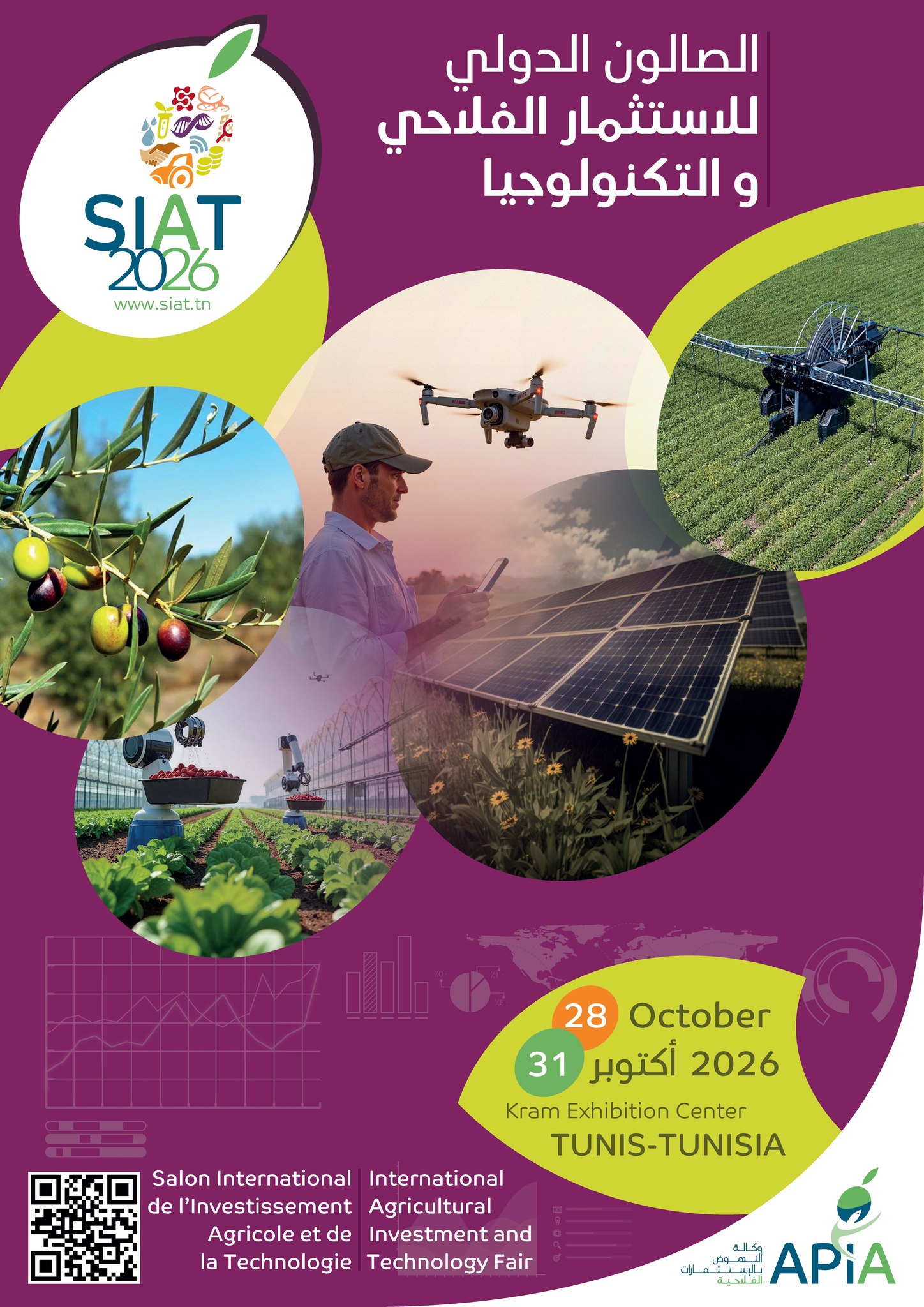
    SIAT 2026 is a pivotal event for the agricultural sector, aiming to facilitate technological transition and innovation. The exhibition will cover over 10,000 square meters, showcasing cutting-edge agricultural technologies and practices.

    It will gather key stakeholders, including producers, researchers, and investors, to discuss sustainable practices and investment opportunities. SIAT 2026 takes place in Tunis, Tunisia.

    Venue: Parc des expositions du Kram.

    TL;DR

    1. 1Dates and Venue: SIAT 2026 runs from October 28 to 31, 2026, at Parc des Expositions du Kram, Tunis, Tunisia.
    2. 2Scale and Focus: This major event showcases agricultural investment and technology, featuring over 180 exhibitors and 15,000 visitors.
    3. 3Organiser: The event is organised by APIA and the Société des Foires Internationales de Tunis.
    4. 4Buyer Authority: Key attendees include agricultural producers, technology providers, and investors in sustainable agriculture.
    5. 5Entry: Registration is available online; confirm details on the official website.

    Why visit

    Attendees will gain insights into the latest agricultural technologies and investment opportunities. The event provides a platform for networking with industry leaders and exploring innovative solutions for sustainable agriculture. Participants can engage in workshops and demonstrations that highlight practical applications of new technologies.

    Why exhibit

    Exhibitors will have the chance to showcase their innovations to a targeted audience of industry professionals and decision-makers. This is an opportunity to establish valuable connections, enhance brand visibility, and explore potential partnerships in the agricultural sector. Exhibiting at SIAT 2026 can lead to increased market reach and business growth.

    Attendees, exhibitors & solutions

    Who this event is for

    Visitor profile

    Typical attendee groups you can expect to meet.

    Farm owners and managers in cereals, olives, citrus, dates and market vegetables sourcing irrigation, mechanisation and crop-protection equipment
    Greenhouse and horticulture growers comparing hydroponic systems, substrates, screens and climate-control kit
    Agri-food processors and packhouses (olive oil, dates, canned vegetables, dairy) evaluating grading lines, packaging and cold-chain equipment
    Agricultural engineers and technical managers from cooperatives and GDAs assessing fertigation, water metering and pump specifications
    Agri-input distributors and dealers scouting brands to represent in Tunisia, Libya and West African markets
    Irrigation and water-management specialists comparing drippers, filters, pivots, borehole pumps and solar pumping kits
    Livestock and dairy producers looking at feed, housing, milking and animal-health solutions
    Agri-finance, leasing and development-project officers meeting technology suppliers, cooperatives and project promoters
    Public-sector and regional development staff monitoring technology adoption, water use and investment incentives
    Researchers, academics and students from Tunisian agricultural institutes and universities
    Export-oriented producers seeking certification, traceability, fumigation and post-harvest solutions for European buyers
    Import/export traders and freight forwarders handling perishable and refrigerated agricultural cargo

    Exhibitor profile

    Main supplier and exhibitor segments present at the show.

    Irrigation and water-technology suppliers: drippers, sprinklers, pivots, filters, pumps, solar pumping and fertigation units
    Agricultural machinery dealers: tractors, tillage implements, sprayers, harvesters, trailers and spare parts
    Greenhouse and hydroponics firms: tunnel and multi-span structures, films, substrates, nutrient dosing and climate control
    Fertiliser and plant-nutrition producers: mineral and organic fertilisers, biostimulants, micronutrients and soil conditioners
    Crop-protection and seed companies: certified seed, seedlings, nurseries, biological control and spray programmes
    Post-harvest and cold-chain suppliers: sorting and grading lines, cold rooms, precooling, refrigerated transport and packaging
    Agri-food processing equipment makers: olive-oil mills, date processing, dairy, canning and drying lines
    Livestock equipment and animal-health suppliers: feed, mineral blocks, milking, housing and veterinary products
    Smart-farming and agri-software providers: soil and weather sensors, farm management platforms, variable-rate application
    Renewable-energy suppliers for farms: photovoltaic pumping, off-grid solar, biogas and energy-efficient drying
    Water infrastructure contractors: well drilling, reservoirs, lined canals, filtration and treated-wastewater reuse systems
    Agri-finance, insurance, certification and advisory bodies exhibiting alongside the equipment halls

    Product categories

    Key solution areas showcased across the event.

    Irrigation systems and components (drip, sprinkler, pivot, filtration, valves)
    Borehole pumps, water lifting and solar pumping
    Water storage, reservoirs and treated-wastewater reuse
    Agricultural machinery and tractors
    Tillage, seeding and crop-care implements
    Greenhouse structures, films, screens and shading
    Hydroponics, substrates and nutrient dosing
    Fertilisers, biostimulants and plant nutrition
    Seeds, seedlings, nurseries and plant propagation
    Crop protection and integrated pest management
    Post-harvest handling, sorting and grading equipment
    Cold chain, cold rooms and refrigerated transport
    Packaging, labelling and palletising for fresh produce
    Olive-oil extraction and date processing equipment
    Dairy, livestock and animal-husbandry equipment
    Farm software, sensors and precision agriculture
    Spare parts, workshop tools and maintenance services
    Agri-finance, insurance, certification and advisory services

    Location & Facilities

    Venue

    Halls & areas

    1
    Parc des Expositions Et Centre de Commerce International de Tunis (Le Kram)

    Parc des expositions du Kram

    Parc des Expositions du Kram, Le Kram, Tunis, Tunisia

    Facilities

    Parking

    Parc des expositions du Kram in Tunis typically provides on-site or adjacent visitor parking during major trade fairs; confirm daily rates, payment methods and hall access on the organiser or venue website before travel.

    Food options

    On-site catering

    On-site dining

    Parking: Parc des expositions du Kram in Tunis typically provides on-site or adjacent visitor parking during major trade fairs; confirm daily rates, payment methods and hall access on the organiser or venue website before travel.

    Gate: Follow organiser signage to the main visitor entrance at Parc des expositions du Kram for badge collection; allow extra time for security screening during peak morning arrival.

    Attend

    Entry & tickets

    Event days & opening times

    DayOpening hours
    October 28 to 31, 2026:10:00 AM – 6:00 PM daily
    Register

    Who runs the show

    Organisers

    APIA (Agence de Promotion des Investissements Agricoles)

    Société des Foires Internationales de Tunis

    How the last edition performed

    Previous edition

    Visitors

    15,000

    Exhibitors

    180

    Intelligence

    Market context

    Key market insights, trends, news and related events to help you understand the bigger picture.

    Tunis, Tunisia

    Why it matters

    On 2026-10-28 to 2026-10-31, SIAT 2026 in Tunis covering Agri-food technologies and equipment, Renewable energy solutions for agriculture, Hydroponic systems and supplies, Organ gives food buyers a single calendar window to compare suppliers, validate specs on the stand, and book follow-ups before the next buying cycle - especially when your roadmap matches the published exhibitor profile.

    Industry trends

    Key trends shaping this market and its wider industry.

    01

    Digital buyer journeys

    What digital buyer journeys means for buyers and exhibitors in this sector.

    02

    Sustainability in procurement

    What sustainability in procurement means for buyers and exhibitors in this sector.

    03

    Automation and labour efficiency

    What automation and labour efficiency means for buyers and exhibitors in this sector.

    04

    Regional supply-chain resilience

    What regional supply-chain resilience means for buyers and exhibitors in this sector.

    05

    Hybrid engagement models

    What hybrid engagement models means for buyers and exhibitors in this sector.

    Plan your trip

    Travel & logistics

    Local currency · TND

    Arrival airports

    Choose from the following airports, with convenient access to the event and venue.

    TUN

    Tunis-Carthage International Airport

    The primary arrival airport for Tunis and the closest to the Le Kram fairground. Taxis and private transfers are the practical option with exhibition equipment; fares are paid in Tunisian dinar, so agree the price or insist on the meter before departure

    Approx. 12-15 km from Parc des Expositions du Kram (estimate; confirm route before travel)

    to venue

    Approx. 20-30 minutes by taxi or pre-booked transfer outside peak hours

    by car

    NBE

    Enfidha-Hammamet International Airport

    A secondary option used by charter and seasonal carriers. Only worth considering if your flight lands there; transfers are longer and should be pre-booked with a fixed price

    Approx. 100-115 km south of Tunis (estimate; confirm route before travel)

    to venue

    Approx. 1 hour 15 minutes to 1 hour 30 minutes by road, traffic dependent

    by car

    MIR

    Monastir Habib Bourguiba International Airport

    Serves the Sahel region and is a long transfer to the Kram fairground. Seasonal schedules change, so confirm flight availability and onward transport before choosing this arrival point

    Approx. 160-175 km south of Tunis (estimate; confirm route before travel)

    to venue

    Approx. 2 hours by road, traffic dependent

    by car

    Hotel tiers

    A range of accommodation options near the venue and across key areas.

    Seven Floors

    midscale
    Le Kram, near Parc des Expositions du Kramapprox. 1.6 km from Le Kram exhibition and trade centre to venue

    USD 150–190 / night

    ADAM Hotel Suites

    upscale
    Le Kram, near Parc des Expositions du Kramapprox. 1.6 km from Le Kram exhibition and trade centre to venue

    USD 150–202 / night

    Novotel Tunis Lac

    upscale (4-star)
    Tunis Lac, approx. 1.8 km from the Kram fairgroundapprox. 1.8 km from Le Kram exhibition and trade centre to venue

    USD 150–190 / night

    Palm Beach Hotel le Kram

    economy
    Le Kram seafrontapprox. 1.9 km from Le Kram exhibition and trade centre to venue

    USD 95–122 / night

    Local transport

    Get around the city with these convenient transport options.

    Taxi / private transfer

    Estimated costApprox. TND taxi/rideshare from TUN to venue (estimate; confirm before travel)
    Best forTunis-Carthage International Airport (TUN) to Parc des expositions du Kram

    Airport-to-Le Kram is the standard arrival leg; the venue sits roughly 1.6-1.9 km from the Le Kram hotel cluster so short taxi hops are also practical between hotels and halls.

    Public transport (bus / light rail / TGM)

    Estimated costTND 2-8 typical single public transport journey (confirm before travel)
    Best forTunis city centre to Le Kram fairground

    Tunisia Transport journey planner and Tunismapper list bus, metro and TGM routes across Tunis; TRANSTU has previously run extra shuttles towards Le Kram for major fairs, so check fair-day shuttles on the SIAT access page.

    Car

    Estimated costFree at most nearby hotel car parks; fairground parking confirmed via venue capture
    Best forLe Kram road access and on-site parking

    Google Maps lists a parking lot at the exhibition grounds (Foire el Kram parking exposant) and free parking at some nearby addresses; allow extra time on opening morning.

    taxi

    Estimated costApprox. TND taxi/rideshare from NBE to venue (estimate; confirm before travel)
    Best forEnfidha-Hammamet International Airport (NBE) to Parc des expositions du Kram

    Approx. 1 hour 15 minutes to 1 hour 30 minutes by road, traffic dependent; A secondary option used by charter and seasonal carriers. Only worth considering if your flight lands there; transfers are longer and should be pre-booked with a fixed price.

    taxi

    Estimated costApprox. TND taxi/rideshare from MIR to venue (estimate; confirm before travel)
    Best forMonastir Habib Bourguiba International Airport (MIR) to Parc des expositions du Kram

    Approx. 2 hours by road, traffic dependent; Serves the Sahel region and is a long transfer to the Kram fairground. Seasonal schedules change, so confirm flight availability and onward transport before choosing this arrival point.

    Weather

    Open-Meteo forecast for Tunis 28-31 October 2026: partly cloudy with highs near 25°C and 22°C on the first two days, then light drizzle with highs near 21-22°C and lows near 13-14°C. Forecast values; confirm before travel.

    Plan for the climate

    Check temperatures and pack accordingly

    Venue connectivity

    Confirm mobile roaming or local SIM options for business visitors to Tunisia.

    Ride-hailing

    Taxis

    Public transit

    Car rentals

    Cultural notes

    Useful information to help you have a smooth and respectful visit.

    Language and business etiquette

    Tunisian Arabic and French are widely used in Tunis commerce; SIAT organiser pages publish English visitor guides alongside French, so English-speaking buyers can plan meetings ahead.

    Local currency

    The Tunisian dinar (TND) is the local currency. Google Hotels and Flights captures were priced in TND, INR and other currencies, so budget in TND for on-the-ground costs such as taxis and meals.

    Fairground location

    The Parc des Expositions sits in Le Kram on the northern edge of Tunis, close to the coast; hotels in Le Kram and Tunis Lac keep transfers short on show mornings.

    Practical guides

    Visitor & Exhibitor Essentials

    Everything needed to arrive prepared, navigate the event, and make the visit productive.

    Flights

    Destination: TUN

    Google Flights showed fares for London and New York departures to Tunis TUN around the SIAT dates; the search page flagged prices as currently high. Fares exclude optional bag fees and were captured on 21 Oct, so re-check live pricing before booking.

    Transport

    Get to the venue and around the city with these options.

    Airport → venue: Primary gateways: Tunis-Carthage International Airport (TUN): Approx. 20-30 minutes by taxi or pre-booked transfer outside peak hours; Enfidha-Hammamet International Airport (NBE): Approx. 1 hour 15 minutes to 1 hour 30 minutes by road, traffic dependent; Monastir Habib Bourguiba International Airport (MIR): Approx. 2 hours by road, traffic dependent. Allow road or rail time to Parc des expositions du Kram; on-site parking is usually available at major exhibition venues.

    Hotel → venue: Precinct hotels near Parc des expositions du Kram: Le Kram, near Parc des Expositions du Kram: Seven Floors; Le Kram, near Parc des Expositions du Kram: ADAM Hotel Suites; Tunis Lac, approx. 1.8 km from the Kram fairground: Novotel Tunis Lac.

    Ride-hail: Ride-hailing apps are commonly used in Tunis; confirm local availability before travel.

    Public transit: Tunisia Transport journey planner and Tunismapper cover bus, metro, train and TGM routes to Le Kram. TRANSTU has added extra shuttles towards the Kram fairground during major fairs, so check the SIAT getting-there page for fair-day services.

    Parking: On-site parking is available at Parc des expositions du Kram; confirm daily rates and hall access on the organiser or venue site.

    Weather

    Plan and pack for the event climate.

    Month: October 2026

    Temperature: Late-October outlook for Tunis: highs near 21-25°C, lows near 13-16°C across 28-31 October 2026 (Open-Meteo forecast).

    Seasonality: Mixed autumn pattern: two partly cloudy days followed by light drizzle on 30-31 October 2026 in the Open-Meteo forecast.

    Packing: Pack light layers for warm afternoons and cooler evenings, plus a compact umbrella or rain shell for the light drizzle forecast late in the show week. Comfortable shoes suit the walk between the Le Kram hotels and the halls.

    Plan your trip

    Planning

    Best day to visit: Day 2 (mid-show)

    Mid-show days at SIAT 2026 usually combine full exhibitor attendance with scheduled B2B meetings, before early pack-down on the final day.

    T-14

    Confirm the SIAT 2026 dates (28-31 October) and daily opening hours on siat.tn, then block the hall days you actually need.

    T-14

    Pre-register for a visitor badge on the organiser site if the form is open, and save the confirmation on your phone.

    T-13

    Book flights into Tunis-Carthage (TUN) and check whether the carrier wants a return ticket and hotel confirmation at check-in.

    T-12

    Reserve a hotel in Le Kram, Tunis Lac or La Marsa; the closest rooms are 1.6 to 1.9 km from the Kram fairground.

    T-11

    Check your passport validity and Tunisia entry requirements for your nationality with the Tunisian embassy or consulate.

    T-10

    Build a target exhibitor list by product group (irrigation, machinery, greenhouse, fertiliser, post-harvest) and note stand numbers once the exhibitor list is published.

    T-9

    Prepare a one-page company profile in French and English plus a QR code to your product catalogue or farm data.

    T-8

    Write 6 to 8 questions per supplier covering capacity, water and energy use, spare parts, local service, delivery lead time, warranty, training and existing references in Tunisia.

    T-7

    Check import and certification rules in your home country for any equipment you may buy at the show.

    T-6

    Plan your cash: the Tunisian dinar is a closed currency, so budget to exchange at Tunis-Carthage Airport or a bank on arrival.

    T-5

    Install a ride-hailing app and note the taxi fallback; the airport-to-venue leg is roughly 20 to 30 minutes outside rush hour.

    T-4

    Download the hall plan and group your priority stands by hall to cut walking time between the Le Kram buildings.

    T-3

    Check the forecast for 28-31 October and pack light layers, a compact rain jacket and shoes suitable for concrete floors and outdoor aprons.

    T-2

    Save the venue address in Arabic and French (Parc des Expositions du Kram, Tunis) so taxi drivers recognise it immediately.

    T-1

    Charge devices, pack business cards, a notebook and a European-style plug adapter (Tunisia uses 230 V, type C and E sockets).

    T-16

    Day 1 (28 October): Arrive at opening, collect the badge, walk the priority halls first and book follow-up meetings for days 2 and 3.

    T-17

    Day 3 or 4: Use the quieter final days for price, delivery and spare-parts negotiation with the stands you shortlisted.

    Sample visitor itinerary

    Route-optimised day
    Day 1 · morning

    Registration and hall orientation at Parc des expositions du Kram

    Day 2 · core sessions

    Supplier meetings and product demos

    Day 3 · wrap-up

    Final negotiations and follow-up

    Networking spots

    2

    SIAT 2026 registration concourse

    Parc des expositions du Kram

    Central meeting point before and between hall appointments during show days.

    Organiser B2B lounge (if offered)

    Parc des expositions du Kram

    Hosted matchmaking and buyer programmes when published by the organiser.

    Budget

    Costs & budget

    Build your working budget

    Adjust the inputs below to create a directional event budget.

    Estimated budget
    Live estimate
    • Hotel × 2 nightsTND 190.000
    • Per diem × 2TND 150.000
    Estimated totalTND 340.000

    This is a directional estimate. Please verify live rates before booking.

    Decision

    Visit, exhibit, or skip?

    Should you go?

    Use this quick check to decide whether SIAT 2026 fits your visit, exhibit or skip plan.

    QUESTION 1 OF 6

    For SIAT 2026, what is your primary role on the show floor?

    Decision matrix

    Compare participation options side by side to choose the best fit for your objectives.

    visit

    Your category focus and target suppliers align with the official exhibitor profile.

    Best for

    Buyers, engineers, and delegates sourcing Agri-food technologies and equipment and Renewable energy solutions for agricult solutions and benchmarking suppliers at SIAT 2026 in Tunis.

    Min. budget

    $554.00

    Timeline

    4-8 weeks before opening day for registration, hotels, and travel.

    Risks

    Session times and ticket tiers may change - confirm the official agenda before booking.

    exhibit

    You have a defined lead-generation or distributor recruitment goal for this market.

    Best for

    Brands and manufacturers launching Agri-food technologies and equipment and Renewable energy solutions for agricult products who need qualified meetings with the event's trade audience.

    Min. budget

    $2,493.00

    Timeline

    3-6 months for stand booking, freight, staffing, and pre-show marketing.

    Risks

    Booth pricing and corner premiums vary by hall - confirm with the organiser sales team.

    skip

    Audience, geography, or commercial goals do not justify travel and stand costs this cycle.

    Best for

    Teams with weak category fit, budget constraints, or overlapping commitments during the Tunis show week.

    Timeline

    N/A

    Risks

    Skipping may mean missing buyer meetings if competitors exhibit or attend the same week.

    FAQs & glossary

    Answers

    Frequently asked

    When and where is SIAT being held in 2026?
    SIAT runs from 28 to 31 October 2026 at the Parc des Expositions du Kram in Tunis, Tunisia. The fairground sits on the northern edge of the city, close to Le Kram and a short drive from Tunis Lac and La Marsa. Daily opening hours and hall access rules are published on the organiser site, siat.tn.
    What can I actually see at SIAT?
    The exhibition covers the equipment side of farming: drip and pivot irrigation, borehole and solar pumps, tractors and implements, greenhouse structures and hydroponic systems, fertilisers and biostimulants, seed and nursery material, crop protection, post-harvest grading and cold rooms, packaging, olive-oil and date processing lines, livestock equipment, and farm software and sensors. Agri-finance, insurance and certification bodies also exhibit.
    Is SIAT trade-only or can the general public attend?
    SIAT is an agricultural trade exhibition and most stands are set up for professional buyers, distributors and project promoters. Some editions also run farmer days with wider public access. Check the visitor information on siat.tn before travelling to confirm whether your dates fall on trade-only or open days.
    How do I register and what should I bring to the venue?
    Registration is handled through the organiser site siat.tn, typically with an online form and a badge collected at the entrance. Bring photo ID, your company details and business cards, and keep the registration confirmation on your phone in case the badge desk asks for it.
    How do I get from Tunis-Carthage Airport to the Kram fairground?
    Tunis-Carthage International Airport (TUN) is roughly 12 to 15 km from the Parc des Expositions du Kram, which is about 20 to 30 minutes by taxi or pre-booked transfer outside rush hour. Fares are paid in Tunisian dinar (TND); agree the price or insist on the meter before departure. Confirm live fares and any fair-day shuttle arrangements with your hotel or the organiser.
    Is there parking at the Parc des Expositions du Kram?
    Yes, the fairground has on-site parking, including an exhibitor parking area. Opening-morning queues are the usual bottleneck, so arrive early and allow extra time if you are driving in from Tunis centre or La Marsa. Confirm current parking charges and gate access on the venue or organiser page.
    Which languages are used at SIAT?
    Arabic and French are the working languages of Tunisian agriculture and of the show floor. Most exhibitors can handle French, many have English-speaking technical staff, and catalogues are often bilingual French/Arabic. If a technical negotiation matters, ask in advance whether an English-speaking engineer will be on the stand.
    What is the weather like in Tunis at the end of October?
    Expect mild, changeable weather: forecast highs of around 21 to 25 degrees Celsius, lows of 13 to 16 degrees Celsius, and a chance of light drizzle on the later show days. Evenings near the coast can feel cool, so bring light layers and a compact rain jacket for the walk between halls and car parks.
    Where should I stay during SIAT?
    The closest cluster is Le Kram, 1.6 to 1.9 km from the fairground, with midscale and upscale options within walking or short taxi distance. Tunis Lac and La Marsa/Gammarth add more upscale rooms within 15 to 25 minutes by road. Book early, because the Le Kram and Lac properties fill up around the exhibition dates.
    Do I need a visa to travel to Tunisia for SIAT?
    Entry rules depend on nationality. Holders of EU, UK, US, Canadian, Swiss and Japanese passports can normally enter visa-free for short business or tourist stays of up to 90 days, while other nationalities must obtain a visa in advance from a Tunisian embassy or consulate. SIAT is not a visa-issuing authority, so confirm your own case with the Tunisian mission in your country before booking flights.
    What currency is used and how should I pay?
    The Tunisian dinar (TND) is a closed currency, so you generally cannot buy it before arrival and exporting it is restricted. Exchange at the airport, a bank or your hotel, keep receipts, and carry cash for taxis and small purchases. Cards are accepted in hotels and larger restaurants, less reliably on the show floor.
    Can I bring agricultural samples, seeds or plant material into Tunisia?
    Plant material, seed and soil samples are subject to Tunisian phytosanitary controls and are often restricted at the border. Speak to the Tunisian plant-protection service and your freight forwarder before shipping or carrying samples, and carry any certificates with the consignment rather than in hand luggage.
    Are there conferences or technical sessions alongside the exhibition?
    SIAT programmes technical sessions and farmer-oriented workshops alongside the halls, covering irrigation, water management, crop nutrition and investment. The agenda and session times for the 2026 edition are published on the organiser schedule page, siat.tn/schedule; check it close to the show because times are updated during the run-up.
    How many days do I need at SIAT?
    One full day is enough for a targeted buyer with a short list of stands. Two to three days suit visitors comparing irrigation, machinery and post-harvest suppliers across multiple halls, and a fourth day is useful for price and delivery negotiations. Exhibitors generally report the first two days as the busiest for qualified trade traffic.

    Glossary

    1
    Drip irrigation
    Delivering water and nutrients directly to the root zone through drippers and micro-tubes. It is the dominant water-saving method for Tunisian orchards, greenhouses and vegetable crops, and a core exhibit category across the SIAT halls.
    2
    Fertigation
    Injecting soluble fertiliser into the irrigation stream so every watering event also feeds the crop. It needs a dosing pump, adequate filtration and a nutrient recipe matched to a soil and water analysis, which is why irrigation and fertiliser suppliers often exhibit next to each other.
    3
    Solar pumping
    Photovoltaic arrays driving borehole or surface pumps, used where grid connections are distant or unreliable. Systems are sized on daily water volume, total head and peak-sun hours, and are usually configured to run without batteries by pumping into a storage tank.
    4
    Hydroponics
    Growing in inert substrate or nutrient solution rather than field soil, usually with recirculated water. It appeals to greenhouse growers working with saline soils or tight water quotas, and the kit on show ranges from Dutch buckets to full nutrient-film benches.
    5
    Greenhouse (tunnel and multi-span)
    Plastic-covered structures that extend the season and protect against wind, hail and insects. Buyers compare span width, film life and UV treatment, ridge ventilation, insect-net mesh size and wind-load design for coastal Tunisian sites.
    6
    Cold chain
    The uninterrupted refrigerated path from harvest to market, covering precooling, cold rooms, refrigerated trucks and cold display. Losses in fruit, vegetables, dairy and dates are largely a cold-chain and handling problem rather than a production problem.
    7
    Post-harvest handling
    Sorting, grading, washing, waxing, drying and packing operations after harvest. This equipment family determines export grade, shelf life and rejection rates for dates, citrus, tomatoes and olive oil.
    8
    Packhouse
    A facility where produce is received, cleaned, graded, weighed, packed and palletised. SIAT exhibitors supply the grading lines, weighing and labelling stations and palletising equipment installed in these buildings.
    9
    Integrated pest management (IPM)
    Combining monitoring, biological control, resistant varieties and targeted chemistry to hold pest populations below economic damage thresholds. Most modern crop-protection programmes presented at the show are framed around IPM, including pheromone trapping and beneficial insects.
    10
    Soil salinity
    Accumulated salts in the root zone that reduce germination, growth and yield. It is a common constraint in irrigated oases and coastal plots, managed through leaching fractions, drainage, gypsum and salt-tolerant varieties.
    11
    Treated wastewater reuse
    Using secondary-treated municipal water for irrigation under Tunisian reuse norms, typically for fodder, orchards, green spaces and industrial crops. It is one of the alternative water sources discussed alongside desalination and reservoir management.
    12
    Aquifer and water table
    Underground water-bearing layers tapped by wells and boreholes. Over-abstraction in parts of Tunisia makes metering, high-efficiency irrigation and alternative sources commercially relevant for equipment buyers at the fair.
    13
    Precision agriculture
    Variable-rate application, soil and weather sensing, yield mapping and farm-management software used to target seed, fertiliser and water. Adoption in Tunisia is led by large estates, service providers and export-oriented farms.
    14
    Olive-oil extraction line
    Milling, malaxing, decanting, filtration and storage equipment that turns olives into oil. Tunisia is one of the world's leading olive-oil exporters, and mills regularly upgrade for higher yield, lower paste temperature and better polyphenol retention.
    15
    Deglet Nour
    The premium Tunisian date variety from the south, sold on the branch, pitted, packed or as paste. It drives demand for sorting and calibration equipment, fumigation, cold storage and export packaging shown at the fair.
    16
    GlobalG.A.P.
    A farm-certification scheme covering food safety, traceability, worker welfare and environmental practice, commonly requested by European retail buyers of Tunisian produce. Certification often triggers investment in record-keeping software, spray equipment and packhouse hygiene.
    17
    GDA (Groupement de Developpement Agricole)
    A Tunisian agricultural development group with a cooperative-style role in pooling equipment purchases, irrigation investment and marketing. GDAs are a common buying channel for machinery, water equipment and inputs.
    18
    APIA
    Agence de Promotion des Investissements Agricoles, the Tunisian agency that administers investment incentives and support schemes for agricultural projects. Its rules shape how farmers finance irrigation, greenhouses and processing equipment.

    Also known as

    Alternate names and search phrases for this event.

    • Agri-Tech events
    • SIAT 2026 Tunis
    • SIAT Tunis 2026
    • Tunis Tunisia
    • Agriculture and Technology Exhibition Tunis 2026
    • Food Technology
    • Sustainable Development
    • Agriculture and Technology Exhibition B2B Trade Expo Tunis
    • Agri-food technologies and equipment

    Digital business cards for the show floor

    Display a free company card at your booth, or share your professional card on the show floor.

    Create a free card