Are you the organiser of this event?

    View as

    Event overview

    Overview

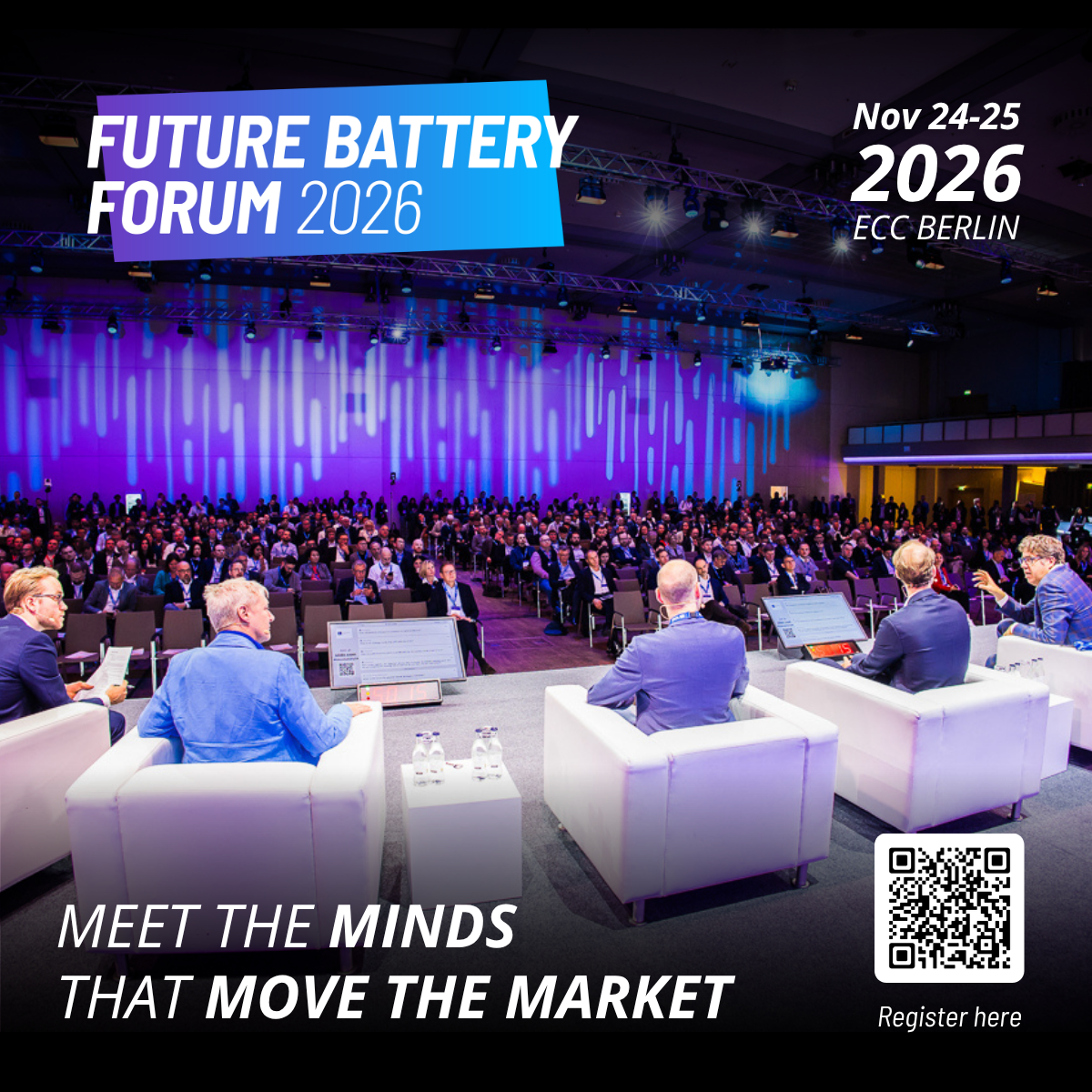
    The Future Battery Forum 2026 is set to be Europe's leading battery conference, taking place at ECC Berlin. This event will bring together key decision-makers from across the battery value chain, including manufacturers, suppliers, and industry experts.

    Attendees can expect high-quality networking opportunities and insights into the latest trends and technologies in battery manufacturing and electric mobility. Future Battery Forum takes place in Berlin, Germany.

    Why visit

    Attendees will gain insights from top industry speakers and participate in valuable networking opportunities. The event will showcase the latest innovations in battery technology and provide a platform for discussions on market strategies and sustainability in the battery sector. Don't miss the chance to connect with over 1,000 decision-makers and experts from the battery industry, enhancing your professional network and knowledge.

    Why exhibit

    Exhibiting at the Future Battery Forum offers unparalleled visibility among industry leaders and decision-makers. Companies can showcase their latest products and innovations, engage directly with potential clients, and participate in meaningful discussions that shape the future of the battery industry. With a targeted audience of over 1,000 attendees, exhibitors will have the opportunity to maximize their reach and impact in the market.

    Attendees, exhibitors & solutions

    Who this event is for

    Visitor profile

    Typical attendee groups you can expect to meet.

    Cell and gigafactory manufacturing engineers - process owners for coating, calendering, slitting, stacking/winding, formation and aging who compare line equipment and yield data
    Automotive OEM and Tier-1 battery strategists - sourcing, pack integration, cell-to-pack and cell-to-chassis architecture leads
    Battery materials and component buyers - cathode and anode active materials, electrolyte, separator, foils, binders and housings
    Equipment, automation and dry-room customers - plant engineers evaluating humidity control, metrology and inline inspection upgrades
    Recycling and circular-economy operators - black mass processing, hydrometallurgy and EU Battery Regulation compliance managers
    Energy utilities, EPCs and system integrators - grid-scale BESS, commercial storage and second-life sourcing
    Investors, analysts and public funding bodies - gigafactory capex, IPCEI and EU innovation funding programme officers
    R&D leaders and academia - cell chemistry, solid-state, sodium-ion and fast-charging research translation
    Regulatory and sustainability affairs managers - carbon footprint rules, due diligence, battery passport readiness
    Purchasing and supply-chain managers - dual-sourcing strategies for European cell supply and raw-material offtake

    Exhibitor profile

    Main supplier and exhibitor segments present at the show.

    Cell manufacturing equipment makers - coating and drying, calendering, slitting, notching, stacking, winding, tab welding, electrolyte filling and formation equipment
    Battery materials producers - CAM, AAM, electrolytes, separators, current collector foils, binders and conductive additives
    Turnkey gigafactory contractors and clean/dry-room specialists - line design, commissioning, HVAC and dehumidification
    Metrology, inspection and quality software vendors - CT and X-ray inspection, inline vision, leak testing and traceability
    Battery management system, power electronics and sensor suppliers - BMS ICs, cell contacting systems, busbars and thermal management
    Recycling technology and plant providers - shredding, sorting, black mass processing and hydrometallurgical recovery
    Testing, certification and safety laboratories - abuse testing, UN 38.3 transport testing, EMC and functional safety
    Engineering consultancies, EPCs and industrial software - MES, digital twin, energy management and plant simulation
    Research institutes and cluster organisations presenting pilot lines, cell prototyping and funded projects

    Product categories

    Key solution areas showcased across the event.

    Battery cells and cell formats - prismatic, cylindrical and pouch
    Cathode active materials - NMC, LFP, LMFP and high-nickel chemistries
    Anode materials - graphite, silicon-dominant and lithium metal
    Electrolytes, separators, binders and conductive additives
    Current collector foils, tabs, busbars and cell housings
    Electrode manufacturing equipment - mixing, coating, drying, calendering and slitting
    Cell assembly equipment - stacking, winding, notching, welding and electrolyte filling
    Formation, aging and end-of-line testing systems
    Dry-room, cleanroom and humidity control technology
    Metrology, inspection and quality assurance systems
    Battery management systems, sensors and power electronics
    Module and pack assembly, cell-to-pack and thermal management
    Recycling, black mass processing and hydrometallurgical recovery
    Second-life applications and stationary battery storage
    Battery testing, certification and safety services
    Industrial software for traceability, MES and battery passport data
    Charging and fast-charging technology for vehicle and stationary use

    Location & Facilities

    Venue

    ECC Berlin (Estrel Congress Center)

    Berlin, Germany

    Facilities

    Parking

    ECC Berlin (Estrel Congress Center) in Berlin typically provides on-site or adjacent visitor parking during major trade fairs; confirm daily rates, payment methods and hall access on the organiser or venue website before travel.

    Food options

    On-site catering

    On-site dining

    Gate: Follow organiser signage to the main visitor entrance at ECC Berlin (Estrel Congress Center) for badge collection; allow extra time for security screening during peak morning arrival.

    Attend

    Entry & tickets

    Event days & opening times

    November 24-25, 2026: Confirm daily opening hours on the organiser registration page.

    Register

    Who runs the show

    Organisers

    Organised by

    IPM AG - Institute for Production Management

    News and context for this year’s event

    Edition highlights

    Edition recap

    The 2025 edition of Future Battery Forum was listed for 25–26 November 2025 in Berlin. The organiser published an FBF25 after-show report along with a 2025 photo gallery and event movie. Future Battery Forum describes itself as Europe's leading battery conference.

    Impact

    The 2025 edition of Future Battery Forum was listed for 25–26 November 2025 in Berlin. The organiser published an FBF25 after-show report along with a 2025 photo gallery and event movie. Future Battery Forum describes itself as Europe's leading battery conference.

    Intelligence

    Market context

    Key market insights, trends, news and related events to help you understand the bigger picture.

    Berlin, Germany

    Why it matters

    Attending Future Battery Forum on 2026-11-24 to 2026-11-25 in Berlin lets buyers and specifiers benchmark suppliers, see live demonstrations, and compress months of vendor meetings into one focused trade visit — worthwhile when your category roadmap aligns with the official exhibitor profile.

    Industry trends

    Key trends shaping this market and its wider industry.

    01

    Digital buyer journeys

    What digital buyer journeys means for buyers and exhibitors in this sector.

    02

    Sustainability in procurement

    What sustainability in procurement means for buyers and exhibitors in this sector.

    03

    Automation and labour efficiency

    What automation and labour efficiency means for buyers and exhibitors in this sector.

    04

    Regional supply-chain resilience

    What regional supply-chain resilience means for buyers and exhibitors in this sector.

    05

    Hybrid engagement models

    What hybrid engagement models means for buyers and exhibitors in this sector.

    Market news

    Latest updates from across the market.

    Electrical Equipment for Engines and Vehicles in Germany

    Read

    Automotive Industry Germany - GTAI

    Read

    Germany Automotive Electrical and Electronics - Market Analysis ...

    Read

    Germany Automotive Electrical and Electronics Research

    Read

    Germany Automotive Industry Report Market Size, Growth, Trends, Report 2035

    Read

    Germany Automotive Manufacturing Market Report 2026 - IMARC Group

    Read

    Plan your trip

    Travel & logistics

    Local currencyEUR

    1 arrival airport near the venue

    Arrival airports

    Gateways with convenient access to the event and venue.

    BER

    Berlin Brandenburg

    Hotel tiers

    A range of accommodation options near the venue and across key areas.

    Areas to stay

    Berlin, short S-Bahn or bus ride to Neukölln · Friedrichsfelde, east Berlin · Friedrichshain · Mitte · Neukölln, attached to the Estrel Congress Center

    Estrel Berlin

    upper
    Neukölln, attached to the Estrel Congress Center

    4-star congress hotel directly at the venue, roughly 200 m from the entrance to the congress levels; breakfast and parking are chargeable. Booking here is the simplest option if your days run from early sessions to evening receptions.

    HOLI City Apart Hotel Berlin

    mid-range
    Berlin, short S-Bahn or bus ride to Neukölln

    3-star apart-hotel with kitchenette-style rooms, rated around 4.1 by guests; free parking is listed. Suits small exhibitor teams staying four or more nights.

    ABACUS Tierpark Hotel

    mid-range
    Friedrichsfelde, east Berlin

    Business hotel near Tierpark with free cancellation and spa facilities listed; 30-40 minutes to the Estrel by S-Bahn and bus via Ostkreuz.

    a&o Hostel Berlin Mitte

    budget
    Mitte

    Hostel with private rooms and dorms, parking and pet-friendly policy listed; practical for junior staff or short two-night trips, with a 30-40 minute transfer to the venue.

    Sunflower Hostel Berlin

    budget
    Friedrichshain

    Lowest-cost option among the shortlisted properties, with basic rooms and shared facilities; reach Neukölln by tram or S-Bahn with one change.

    Local transport

    Get around the city with these convenient transport options.

    S-Bahn and bus

    Estimated costEUR 35-85 taxi or rideshare to the venue district
    Best forSonnenallee station (S41/S42 Ringbahn) to Estrel Congress Center, Sonnenallee 225

    The Ringbahn stops at Sonnenallee about 1.5 km from the Estrel; local buses run along Sonnenallee towards the venue, or the walk takes around 18-20 minutes. Use the BVG route planner for live connections during the event.

    train

    Estimated costEUR 10-22 airport or regional rail single journey
    Best forBER airport rail station to Berlin Ostkreuz or Hauptbahnhof, then S41/S42 to Sonnenallee

    FEX and regional services connect BER with the city in about 30 minutes. Change at Ostkreuz for the Ringbahn, which is the fastest rail approach to Neukölln.

    taxi

    Estimated costApprox. EUR 40-60 for the 20 km trip; confirm the meter fare on arrival
    Best forBerlin Brandenburg (BER) to ECC Berlin (Estrel Congress Center)

    Roughly 25-40 minutes depending on traffic on the A113 and Sonnenallee. Taxis wait outside the BER terminals; the return trip can be pre-booked at the Estrel reception.

    ride-hail

    Estimated costApprox. EUR 35-65 depending on app, time of day and surge
    Best forBER terminals or central Berlin hotels to Estrel Congress Center

    Uber, Bolt and FreeNow operate in Berlin. Pick-up points at BER are signposted outside the terminals; allow extra time during morning peak.

    car

    Estimated costFuel and parking only; on-site parking at the venue is chargeable
    Best forA113 motorway exit towards Sonnenallee and the Estrel complex

    The venue sits close to the A113 ring road, which makes it practical for teams driving from Dresden, Leipzig or Poland. Berlin's low-emission zone rules apply in the city centre, so check your vehicle sticker before driving in.

    Getting to the venue

    Practical routes from arrival points and hotels.

    • Airport → venue

      Primary gateways: Berlin Brandenburg (BER). Allow road or rail time to ECC Berlin (Estrel Congress Center); on-site parking is usually available at major exhibition venues.

    • Hotel → venue

      Precinct hotels near ECC Berlin (Estrel Congress Center): Neukölln, attached to the Estrel Congress Center: Estrel Berlin; Berlin, short S-Bahn or bus ride to Neukölln: HOLI City Apart Hotel Berlin; Friedrichsfelde, east Berlin: ABACUS Tierpark Hotel.

    • Ride-hail

      Uber, Bolt and FreeNow all operate in Berlin, with app-based hailing covering the Estrel Congress Center and BER airport. A ride from central Berlin to Neukölln typically takes 20-30 minutes and a BER transfer 25-40 minutes, with prices close to metered taxis outside surge periods. Set the pick-up point at the Estrel main entrance on Sonnenallee rather than the hotel side entrance, and expect longer waits when the conference day ends.

    • Public transit

      Berlin's BVG network covers the venue well. The S41/S42 Ringbahn stops at Sonnenallee station about 1.5 km from the Estrel, with local buses continuing along Sonnenallee towards the congress center; the walk takes around 18-20 minutes. From BER, take the FEX or a regional train to Ostkreuz and change onto the Ringbahn. A Berlin AB single ticket costs approximately EUR 3.50-4.00, and the airport journey needs an ABC ticket; buy through the BVG app or ticket machines and validate before boarding. Confirm live connections and any event shuttle on the organiser's site.

    • Parking

      The Estrel complex has chargeable on-site parking for hotel guests and congress visitors, with direct access to the congress levels; confirm the current day rate and whether pre-booking is possible when you reserve. Street parking in Neukölln is largely resident-permit controlled and fills quickly, so arriving by S-Bahn or taxi is usually simpler. For exhibitors with freight or large equipment, use the venue's designated delivery access and unloading windows rather than the visitor car park.

    Weather

    Typical November 2026 conditions

    Daytime highs typically 6-9 C, overnight lows around 1-4 C in Berlin in November

    Late autumn in Berlin means frequent overcast days and roughly 10-11 rain days across November, usually light drizzle rather than heavy rain. Daylight is short, with sunset before 16:30 CET late in the month, so plan evening meetings indoors or early.

    What to pack: Pack a warm waterproof coat, a compact umbrella, layers you can remove in the heated congress halls, closed comfortable shoes for walking between session rooms and Sonnenallee transport stops, and a small bag that keeps documents dry. A power bank and a European type F adapter are worth including for long exhibition days.

    November in Berlin is late autumn: overcast skies dominate, daytime highs typically sit between 6 and 9 C, and overnight lows drop to around 1-4 C. Rain falls on roughly 10-11 days across the month, usually as light drizzle rather than heavy downpours, and daylight fades by about 16:30 CET. Indoor halls at the Estrel are heated, so the practical challenge is the walk between transport stops, hotel and venue rather than the session rooms. Check the forecast in the week before travel.

    Venue connectivity

    Stay connected at the event

    • Complimentary Wi‑Fi

      EU roaming rules apply, so visitors with a SIM from another EU or EEA country can use their home allowance in Germany at no extra cost; travellers from outside the EU should buy a local prepaid SIM or eSIM from Telekom, Vodafone or O2, which requires a passport for registration. Free Wi-Fi is normally available in the Estrel lobby and conference areas, but mobile data is more reliable for lead capture on the exhibition floor. Bring a European power adapter (type F, 230 V) and a power bank for long days away from your hotel.

    • Venue Wi‑Fi
    • Mobile signal

    Cultural notes

    Useful information to help you have a smooth and respectful visit.

    Language in the halls

    German is the local language, but the battery and automotive engineering community works in English and the conference programme is published in English. Opening small talk in German is appreciated but not expected; technical discussions move to English quickly.

    Punctuality and scheduling

    German business culture treats start times seriously. Sessions at the Estrel begin on the published minute, and supplier meetings booked for 10:00 may finish at 10:30 sharp. Arrive five minutes early and bring an agenda for each meeting.

    Payment, tipping and Sunday closures

    The currency is the euro. Cards are widely accepted in hotels and restaurants, though some bakeries and kiosks in Neukölln remain cash-only. A 5-10% tip is normal in restaurants; round up rather than leaving small coins. Most shops close on Sundays, so buy essentials on Saturday.

    Trade-fair etiquette

    Exchange business cards with both hands and take a moment to read the card before putting it away. Address counterparts with Herr or Frau plus surname until invited to use first names. Direct technical questions are normal and welcome; vague marketing language is not.

    Sustainability expectations

    Berlin venues and German industrial customers expect visible sustainability practice. Reusable cups, public transport use and digital brochures are noticed; printed one-page datasheets are still useful at the booth, but avoid single-use giveaways.

    Beyond the venue

    The Estrel sits in Neukölln, close to Tempelhofer Feld and the Landwehr Canal, both good for a morning run. For evening dinners, Kreuzberg and Mitte are a short S-Bahn ride away, and the Brandenburg Gate and Museum Island are reachable on the same Ringbahn and U-Bahn network.

    Practical guides

    Visitor & Exhibitor Essentials

    Everything needed to arrive prepared, navigate the event, and make the visit productive.

    Flights

    Destination: BER

    BER is Berlin's only commercial passenger airport, so all flights into the city land there, in Terminal 1 or Terminal 2. Book six to ten weeks ahead: November is outside the summer peak, but fares rise when Berlin's congress calendar is busy and Sunday evening departures are the first to sell out. Allow 60-75 minutes from landing to the Estrel via the airport rail station and Ringbahn, or 25-40 minutes by taxi. If you travel with battery samples or demonstration cells, check the airline's dangerous goods rules and any carrier documentation well before departure.

    Visa

    Schengen short-stay rules apply for Germany. Visa-exempt nationals can attend without a visa; others need a Schengen business visa before travelling, with an invitation letter from the organiser supporting the application.

    Processing: Varies by nationality; apply several weeks before travel.

    Apply at the German mission responsible for your place of residence; the Federal Foreign Office business visa page and the local mission checklist list required documents including employer letter and travel insurance.

    Official

    Plan your trip

    Planning

    Best day to visit: Day 2 (mid-show)

    Mid-show days at Future Battery Forum usually combine full exhibitor attendance with scheduled B2B meetings, before early pack-down on the final day.

    T-1

    T-14: Confirm your registration category and download the confirmation QR code plus a photo ID for the badge desk at the Estrel Congress Center.

    T-2

    T-14: Open the published schedule and shortlist the manufacturing, materials and recycling sessions you will attend; note clashes between parallel tracks.

    T-3

    T-13: Book the Berlin hotel and lock the BER flight; check whether your hotel is walkable to Sonnenallee or needs an S-Bahn connection.

    T-4

    T-12: Request meetings with the equipment, materials and recycling suppliers on your shortlist and agree 30-minute slots before the hall gets busy.

    T-5

    T-10: Check your Schengen visa or entry status for Germany and, if needed, request the organiser's invitation letter and travel insurance.

    T-6

    T-9: Prepare a one-page sourcing brief with your cell format, chemistry and throughput targets so supplier conversations are concrete.

    T-7

    T-7: Download the BVG route planner and save the S41/S42 Ringbahn and Sonnenallee bus options, plus a taxi fallback from BER.

    T-8

    T-6: Check the November Berlin forecast and pack a warm waterproof coat, layers and comfortable shoes for the walk between halls and transport stops.

    T-9

    T-5: Confirm any side events, partner workshops or evening receptions and RSVP where a separate registration is required.

    T-10

    T-4: Set up lead capture on your phone or print note sheets so booth conversations convert into follow-up actions.

    T-11

    T-3: Print or save offline copies of your agenda, hotel confirmation and insurance documents in case of poor connectivity.

    T-12

    T-2: Check in for your flight and confirm the BER terminal, then plan 60-75 minutes from landing to the venue by rail.

    T-13

    T-1: Charge devices and power banks, and pack business cards; the Estrel halls have long days of walking and standing.

    Day 1

    Arrive 30-45 minutes before the opening session to collect your badge, orient yourself in the exhibition and secure seats in the main plenary.

    Sample visitor itinerary

    Route-optimised day
    Day 1 · morning

    Registration and hall orientation at ECC Berlin (Estrel Congress Center)

    Day 2 · core sessions

    Supplier meetings and product demos

    Day 3 · wrap-up

    Final negotiations and follow-up

    Networking spots

    2

    Future Battery Forum registration concourse

    ECC Berlin (Estrel Congress Center)

    Central meeting point before and between hall appointments during show days.

    Organiser B2B lounge (if offered)

    ECC Berlin (Estrel Congress Center)

    Hosted matchmaking and buyer programmes when published by the organiser.

    Budget

    Costs & budget

    Build your working budget

    Adjust the inputs below to create a directional event budget.

    Estimated budget
    Live estimate
    • Hotel × 2 nights€190.00
    • Per diem × 2€150.00
    Estimated total€340.00

    This is a directional estimate. Please verify live rates before booking.

    Decision

    Visit, exhibit, or skip?

    Should you go?

    Use this quick check to decide whether Future Battery Forum fits your visit, exhibit or skip plan.

    QUESTION 1 OF 6

    What is your primary role?

    Decision matrix

    Compare participation options side by side to choose the best fit for your objectives.

    visit

    Your category focus aligns with the official product themes.

    Best for

    Buyers, researchers, and delegates evaluating the programme and networking value.

    Min. budget

    $400.00

    Timeline

    4-8 weeks before opening day for registration and travel.

    Risks

    Limited session times published - confirm agenda before booking.

    exhibit

    You have a clear lead-generation or launch goal for this market.

    Best for

    Suppliers and brands seeking qualified meetings with the event audience.

    Min. budget

    $2,500.00

    Timeline

    3-6 months for stand booking, freight, and marketing prep.

    Risks

    Booth pricing not published in captured sources - confirm with organiser.

    skip

    Programme, audience, or commercial goals do not match your plan.

    Best for

    Teams whose category or region fit is weak this edition.

    Timeline

    N/A

    Risks

    No major risks listed.

    FAQs & glossary

    Answers

    Frequently asked

    What is the Future Battery Forum and what does it cover?
    The Future Battery Forum is a Berlin-based industry conference and exhibition dedicated to battery cell manufacturing, gigafactory build-out, battery materials, pack integration and recycling. The event combines plenary and track sessions with an exhibition of equipment, materials, software and recycling suppliers. The 2026 edition takes place in November 2026 at the Estrel Congress Center in Berlin, and the published programme is the authoritative agenda source.
    Who typically attends the Future Battery Forum?
    The audience is drawn from cell manufacturers and gigafactory project teams, automotive OEMs and Tier-1 suppliers, battery materials producers, equipment and automation vendors, recycling companies, energy utilities and storage integrators, research institutes, and investors or public funding bodies. Most attendees are engineers, purchasing and strategy leads, or technology scouts rather than general consumers.
    Where exactly is the venue and how do I get there from Berlin Brandenburg Airport?
    The venue is the Estrel Congress Center at Sonnenallee 225 in Berlin-Neukölln. From Berlin Brandenburg (BER) take the FEX or a regional train, or the S-Bahn, into the city and continue on the S41/S42 Ringbahn to Sonnenallee station, then a short bus ride or taxi along Sonnenallee to the Estrel. A direct taxi or ride-hail from BER is roughly 25-40 minutes depending on traffic.
    Which topics dominate the programme?
    Typical tracks cover cell and electrode production, dry-room and quality technology, battery materials and cell chemistries including LFP, high-nickel NMC, solid-state and sodium-ion, module and pack integration, recycling and circular economy, and the regulatory and funding environment for European gigafactories. Confirm the current track list on the schedule page before you build your personal agenda.
    Is there an exhibition alongside the conference, or only sessions?
    The event is a combined conference and exhibition format: suppliers of production equipment, materials, metrology, BMS electronics and recycling technology exhibit alongside the stage programme. That means you can compare equipment vendors and materials suppliers in the same visit as your conference sessions.
    What language are the sessions held in?
    The programme is published in English and the audience is international, so sessions are generally delivered in English. If a specific workshop or partner session is held in another language, that is usually indicated in the agenda entry, so check the individual session listing before you commit to a track.
    How do I register, and are there different pass types?
    Registration is handled through the official website. Pass types, group rates and any exhibitor or partner registrations change from edition to edition, so check the current registration page for the valid categories rather than relying on previous years. Bring the confirmation QR code and a photo ID to the badge desk at the Estrel.
    Can I get a visa invitation letter for a Schengen business visa?
    German missions normally expect a business visa application supported by an invitation letter from the organiser, proof of accommodation for the full stay, travel medical insurance covering the Schengen area, and evidence of employment or company registration. Request the invitation letter from the organiser's registration team as soon as your registration is confirmed, and apply well before the November event dates.
    Is the Estrel Congress Center accessible for visitors with reduced mobility?
    The Estrel Congress Center is a modern congress hotel with step-free access to its conference levels and lifts between floors. For specific needs such as wheelchair spaces in session rooms, sign-language support or assistance at the badge desk, contact the organiser in advance so the venue can prepare.
    What should I wear and how should I plan my days?
    Business casual is the norm: jacket without a tie for most attendees, comfortable shoes for the walk between session rooms and exhibition stands. November in Berlin is cold and often wet, so bring a warm waterproof outer layer for the transfer between hotel and venue. Plan two half-days minimum for the exhibition if you are sourcing equipment, and book meetings before arrival because senior supplier teams are heavily scheduled.
    How far in advance should I book flights and hotels?
    Book six to ten weeks ahead for both. November is outside Berlin's summer peak, but the Estrel and the hotels around Neukölln, Mitte and Alexanderplatz fill quickly when a large congress is in town. Staying at the Estrel itself removes the daily transfer entirely, while Neukölln and Mitte hotels work well if you want to combine the event with city meetings.
    Are conference sessions recorded or streamed?
    Recording and streaming arrangements are set by the organiser for each edition and are not guaranteed for every track. If access to recordings matters for your team, confirm it with the organiser before booking, and ask specifically whether the manufacturing and materials tracks are included.

    Glossary

    1
    Gigafactory
    A large-scale battery cell plant, usually rated in tens of GWh of annual output, that combines electrode production, cell assembly, formation and often pack assembly on one site.
    2
    Cell format
    The physical construction of a battery cell. Prismatic and cylindrical cells use rigid metal cans, while pouch cells use a flexible aluminium laminate film; format choice drives packing efficiency, thermal behaviour and manufacturing equipment.
    3
    LFP (lithium iron phosphate)
    A cathode chemistry using iron and phosphorus instead of nickel and cobalt. It offers long cycle life and lower material cost, with lower energy density than high-nickel NMC.
    4
    NMC (nickel manganese cobalt)
    A layered oxide cathode chemistry where the nickel share sets energy density. High-nickel NMC is used for long-range passenger EVs; cobalt content is a cost and due-diligence issue.
    5
    Solid-state battery
    A cell in which the liquid electrolyte is replaced by a solid electrolyte, promising higher energy density and improved safety. Industrialisation depends on interface stability and scalable processing.
    6
    Sodium-ion battery
    A cell chemistry using abundant sodium instead of lithium, positioned for cost-sensitive, cold-climate and stationary storage applications with lower energy density.
    7
    Cell-to-pack and cell-to-chassis
    Pack architectures that integrate cells directly into the pack or vehicle body, removing module housings to raise volume utilisation and reduce part count.
    8
    Dry room
    A production area with humidity controlled to very low dew points so that moisture-sensitive electrode and electrolyte steps do not degrade cell performance. Dry-room energy demand is a major share of gigafactory operating cost.
    9
    Formation and aging
    The first controlled charge and discharge cycles after cell assembly, followed by a rest period, that build the solid electrolyte interphase and let defective cells be screened out before shipping.
    10
    Black mass
    The shredded and separated output of end-of-life lithium-ion batteries, containing mixed cathode and anode powders that are further processed hydrometallurgically or pyrometallurgically to recover nickel, cobalt, manganese, copper and lithium.
    11
    Hydrometallurgy
    Aqueous leaching and separation route used in battery recycling to recover metals as salts at lower temperature than pyrometallurgical smelting, allowing higher lithium recovery.
    12
    Second life
    Reuse of vehicle batteries that no longer meet automotive performance requirements in stationary storage, often after testing and reconfiguration into larger packs.
    13
    EU Battery Regulation
    Regulation (EU) 2023/1542 sets sustainability, labelling and due-diligence duties across the battery life cycle, including carbon footprint declarations, minimum recycled content and the digital battery passport.
    14
    Battery passport
    A digital record, required under the EU Battery Regulation, that carries a unique identifier and shares performance, durability, carbon footprint and material composition data across the battery value chain.
    15
    BMS (battery management system)
    The electronics and software that monitor cell voltage and temperature, estimate state of charge and state of health, and protect the pack against overcharge, over-discharge and thermal events.
    16
    TRL (technology readiness level)
    A 1-9 scale used by funding bodies and industrial partners to describe how close a technology is to commercial deployment; battery pilot lines typically sit between TRL 5 and TRL 7.

    Also known as

    Alternate names and search phrases for this event.

    • Future Battery Forum
    • Battery Conference Berlin
    • Battery Technology Event
    • Battery Industry Networking
    • Future Battery Forum 2026
    • Future Battery Forum Berlin
    • Battery Manufacturing
    • Battery Manufacturing Berlin
    • Electric Mobility
    • Electric Mobility Berlin

    7 more alternate names hidden

    This event guide is reviewed and updated on TradeShowIntel. Last refresh: .