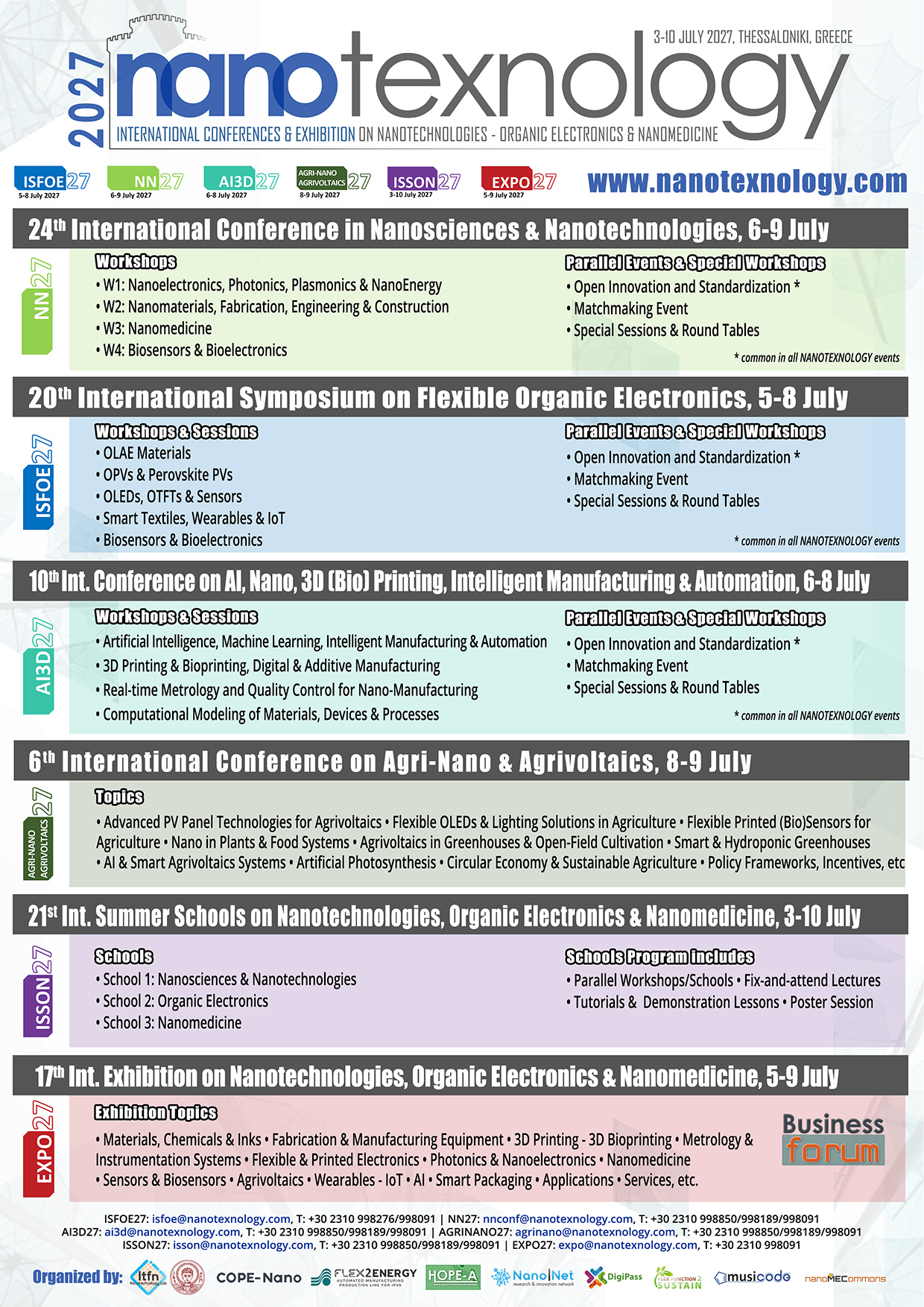
NANOTEXNOLOGY 2027 είναι μια πλατφόρμα πολλαπλών εκδηλώσεων για τεχνολογία, δικτύωση και matchmaking που θα πραγματοποιηθεί στη Thessaloniki, Greece, από 3 έως 10 Ιουλίου 2027. Περιλαμβάνει τέσσερα διεθνή συνέδρια, θερινές σχολές, έκθεση και επιχειρηματικό φόρουμ που καλύπτουν νανοτεχνολογίες, οργανικά ηλεκτρονικά, νανοϊατρική, AI, 3D εκτύπωση, agri‑nano και αγρο‑φωτοβολταϊκά. Το γεγονός προσελκύει περισσότερους από 2.000 ερευνητές, επιστήμονες, μηχανικούς και επαγγελματίες του επιχειρηματικού κόσμου από όλο τον κόσμο. Στόχος του είναι να προωθήσει την ερευνητική και βιομηχανική συνεργασία και να ενισχύσει το οικοσύστημα καινοτομίας.
NANOTEXNOLOGY 2027 είναι το μεγαλύτερο ετήσιο ευρωπαϊκό γεγονός τεχνολογίας, δικτύωσης και matchmaking στον τομέα των νανοτεχνολογιών, των οργανικών και εκτυπωμένων ηλεκτρονικών και της νανοϊατρικής, που θα πραγματοποιηθεί από 3 έως 10 Ιουλίου 2027 στη Thessaloniki, Greece. Συνδυάζει το 24ο Διεθνές Συνέδριο για τις Νανοεπιστήμες & τις Νανοτεχνολογίες (NN27), το 20ό Διεθνές Συμπόσιο για τα Ευέλικτα Οργανικά Ηλεκτρονικά (ISFOE27), το 10ο Διεθνές Συνέδριο για AI, Nano, 3D (Bio)Printing, Intelligent Manufacturing and Automation (AI3D27), το 6ο Διεθνές Συνέδριο για Agri-Nano & Agrivoltaics (AGRINANO27), τις 21ες Διεθνείς Θερινές Σχολές (ISSON27), την 17η Διεθνή Έκθεση για Νανοτεχνολογίες, Οργανικά Ηλεκτρονικά & Νανοϊατρική (EXPO 2027) και ένα Επιχειρηματικό Φόρουμ.
Το γεγονός συγκεντρώνει περισσότερους από 2. 000 ερευνητές, επιστήμονες, μηχανικούς, επιχειρηματικούς, τεχνικούς και φορείς πολιτικής για την προώθηση της έρευνας και των βιομηχανικών συνεργασιών, την αναγνώριση προτεραιοτήτων και την ενίσχυση του οικοσυστήματος καινοτομίας.
Why visit
Η επίσκεψη στο NANOTEXNOLOGY 2027 σας παρέχει πρόσβαση στην πιο πρόσφατη έρευνα και τις βιομηχανικές εξελίξεις στους τομείς των νανοτεχνολογιών, των οργανικών ηλεκτρονικών, της νανοϊατρικής, του AI, της 3D εκτύπωσης και των αγρο‑φωτοβολταϊκών. Μπορείτε να παρακολουθήσετε τέσσερα διεθνή συνέδρια, εξειδικευμένα εργαστήρια, θερινές σχολές και ένα επιχειρηματικό φόρουμ, όλα σε μία τοποθεσία. Η εκδήλωση είναι ιδανική για την αναγνώριση νέων τεχνολογιών, τη συνάντηση με πιθανούς συνεργάτες και την ενημέρωση για χρηματοδοτούμενα από την ΕΕ έργα και τάσεις εμπορευματοποίησης. Η δικτύωση με περισσότερους από 2.000 επαγγελματίες από την ακαδημαϊκή κοινότητα και τη βιομηχανία μπορεί να επιταχύνει τα δικά σας έργα και επιχειρηματικούς στόχους.
Why exhibit
Η συμμετοχή ως εκθέτης στο NANOTEXNOLOGY 2027 τοποθετεί την εταιρεία σας μπροστά σε περισσότερους από 2.000 ερευνητές, μηχανικούς, επιχειρηματικούς ηγέτες και φορείς πολιτικής που δραστηριοποιούνται στις νανοτεχνολογίες, τα οργανικά ηλεκτρονικά και τη νανοϊατρική. Η αφιερωμένη EXPO λειτουργεί παράλληλα με τέσσερα διεθνή συνέδρια και ένα επιχειρηματικό φόρουμ, δημιουργώντας πολλαπλές ευκαιρίες για δημιουργία leads, επίδειξη προϊόντων και συζητήσεις συνεργασίας. Με συμμετέχοντες από την ακαδημαϊκή κοινότητα και τη βιομηχανία, οι εκθέτες μπορούν να παρουσιάσουν καινοτομίες, να λανσάρουν νέα προϊόντα και να συνδεθούν με βασικούς αποφασιστές σε ένα στοχευμένο B2B περιβάλλον.
Attendees, exhibitors & solutions
Who this event is for
Visitor profile
Typical attendee groups you can expect to meet.
Ερευνητές και επιστήμονες
Μηχανικοί και τεχνικοί επαγγελματίες
Υπεύθυνοι ανάπτυξης επιχειρήσεων
Φορείς χάραξης πολιτικής και κυβερνητικοί εκπρόσωποι
Ακαδημαϊκοί και φοιτητές
Επενδυτές και κεφαλαιούχοι επιχειρηματικού κινδύνου
Επαγγελματίες του κλάδου σε ηλεκτρονικά και υλικά
Ιατρικοί και επαγγελματίες υγείας
Ειδικοί αγροτεχνολογίας
Υπεύθυνοι μεταφοράς τεχνολογίας
Exhibitor profile
Main supplier and exhibitor segments present at the show.
Εταιρείες νανοτεχνολογίας
Κατασκευαστές οργανικών και εκτυπωμένων ηλεκτρονικών
Εταιρείες νανοϊατρικής και βιοτεχνολογίας
Προμηθευτές υλικών και εξοπλισμού
Πάροχοι λύσεων AI και 3D εκτύπωσης
Επιχειρήσεις αγρο‑νάνο και αγρο‑φωτοβολταϊκών (agrivoltaics)
Ερευνητικοί οργανισμοί και πανεπιστήμια
Νεοφυείς επιχειρήσεις και spin-offs
Συμβουλευτικές και μηχανικές υπηρεσίες
Κονσόρτια έργων που χρηματοδοτούνται από την ΕΕ
Product categories
Key solution areas showcased across the event.
Nanomaterials and nanoparticles
Organic and large-area electronics (OLAE) materials and devices
Nanomedicine and drug-delivery platforms
Nanofabrication and characterisation equipment
Printed, flexible and 3D/bio-printing technologies
AI and machine learning for intelligent manufacturing in nanotech
Thessaloniki International Exhibition Centre (HELEXPO), Thessaloniki, Greece
Facilities
Parking
Thessaloniki International Exhibition Centre in Thessaloniki typically provides on-site or adjacent visitor parking during major trade fairs; confirm daily rates, payment methods and hall access on the organiser or venue website before travel.
Accessibility
Major convention centres usually offer step-free routes and accessible restrooms; request an accessibility map from the organiser.
Food options
On-site catering
Gate: Follow organiser signage to the main visitor entrance at Thessaloniki International Exhibition Centre for badge collection; allow extra time for security screening during peak morning arrival.
This agenda is still being finalised. Check the official agenda for the latest sessions.
News and context for this year’s event
Edition highlights
Edition recap
NANOTEXNOLOGY 2026 was the most recent completed edition before the 2027 event, held in Thessaloniki, Greece. The official site highlighted the 2026 invited speakers and programme overview for the nanotechnology conferences and exhibition. The edition continued the event’s focus on nanotechnology research, networking and exhibition activity.
Impact
NANOTEXNOLOGY 2026 was the most recent completed edition before the 2027 event, held in Thessaloniki, Greece. The official site highlighted the 2026 invited speakers and programme overview for the nanotechnology conferences and exhibition. The edition continued the event’s focus on nanotechnology research, networking and exhibition activity.
Intelligence
Market context
Thessaloniki, Greece
Why it matters
Attendees will gain insights into the latest advancements in nanotechnology and organic electronics, network with industry leaders, and explore new business opportunities. This event is the largest technology and networking event in Europe, focusing on nanotechnology and organic electronics.
Industry trends
Key trends shaping this market and its wider industry.
01
Digital buyer journeys
What digital buyer journeys means for buyers and exhibitors in this sector.
02
Sustainability in procurement
What sustainability in procurement means for buyers and exhibitors in this sector.
03
Automation and labour efficiency
What automation and labour efficiency means for buyers and exhibitors in this sector.
04
Regional supply-chain resilience
What regional supply-chain resilience means for buyers and exhibitors in this sector.
05
Hybrid engagement models
What hybrid engagement models means for buyers and exhibitors in this sector.
Book hotels and meetings 8-12 weeks before opening day; peer shows in the same sector often fall in adjacent months.
Buyers covering technology often plan Nanotexnology 2026 2027 alongside regional peer shows to compare products, pricing, and service coverage across markets.
Peer events are widely known sector fairs; verify dates on each organiser website before booking.
Plan your trip
Travel & logistics
Local currencyUSD
Hotel tiers
A range of accommodation options near the venue and across key areas.
Check-in (recommended)
2027-07-02
Check-out (recommended)
2027-07-11
Areas to stay
City centre, Thessaloniki
3-star
City centre, Thessaloniki
Mid-range city-centre options such as Astoria Hotel Thessaloniki (3-star, free Wi-Fi, breakfast and parking for a fee) give a short ride to the HELEXPO fairground. Rate band is an estimate converted from captured Google Hotels pricing.
Serviced suites
City centre, Thessaloniki
Apartment-style stays such as Tower 15 Suites and Noima Luxury Suites offer kitchen facilities for longer show-week stays; both appear in the captured Google Hotels results for the show dates.
Local transport
Get around the city with these convenient transport options.
Metro
Estimated costUSD 2.50-6 single metro/light-rail journey (contactless)
Best forThessaloniki Metro network serving the city centre
Thessaloniki Metro opened and links central city stops; check thessmetro.gr for the current network map and fares.
Bus
Estimated costUSD 2.50-6 single metro/light-rail journey (contactless)
Best forOSETH urban buses between the city centre and the HELEXPO fairground area
Urban bus tickets are sold at kiosks and ticket machines; validate on boarding.
Taxi
Estimated costUSD 35–75 taxi or rideshare to the venue district
Best forCity centre and airport to the Thessaloniki International Exhibition Centre
Metered taxis are available at the airport and city ranks; agree the fare band before departure for airport runs.
taxi
Estimated costApprox. USD taxi/rideshare from SKG to venue (estimate; confirm before travel)
Best forThessaloniki Airport Makedonia (SKG) to Thessaloniki International Exhibition Centre
taxi
Estimated costApprox. USD taxi/rideshare from ATH to venue (estimate; confirm before travel)
Best forAthens International Airport Eleftherios Venizelos (ATH) to Thessaloniki International Exhibition Centre
taxi
Estimated costApprox. USD taxi/rideshare from KVA to venue (estimate; confirm before travel)
Best forKavala International Airport Alexander the Great (KVA) to Thessaloniki International Exhibition Centre
Getting to the venue
Practical routes from arrival points and hotels.
Airport → venue
Use the nearest international airport serving Thessaloniki; Metro, train or taxi links are typically available to the venue district.
Hotel → venue
Precinct hotels near Thessaloniki International Exhibition Centre: City centre, Thessaloniki: City centre, Thessaloniki; City centre, Thessaloniki: City centre, Thessaloniki.
Ride-hail
Ride-hailing apps are commonly used in Thessaloniki; confirm local availability before travel.
Public transit
Check local bus/metro options for routes to Thessaloniki International Exhibition Centre.
Parking
On-site parking is available at Thessaloniki International Exhibition Centre; confirm daily rates and hall access on the organiser or venue site.
Plan your trip
Visa & entry documents
Check the latest visa requirements and entry guidelines before travelling.
Greece is a Schengen state; visa-exempt nationals can attend for short business visits, other nationals need a Schengen short-stay visa.
Confirm nationality-specific rules on the Hellenic Ministry of Foreign Affairs visa pages and apply through the Greek consulate or visa centre in your country of residence.
Greece is a Schengen state. Whether you need a visa depends on nationality: EU/EEA and many other passport holders travel visa-free for short business visits, while other nationals need a Schengen short-stay visa applied for at the Greek consulate before travel. Confirm your case with the Hellenic Ministry of Foreign Affairs.
For a Schengen short-stay visa, apply at the Greek consulate or visa centre in your country of residence, bring an invitation or registration confirmation from the event, proof of accommodation and travel insurance, and allow several weeks before departure. Rules differ by nationality, so check the MFA page for your passport.
Processing: Varies by nationality; apply several weeks before travel.
July days in Thessaloniki typically run warm to hot, with averages around the low 30s Celsius and cooler evenings; check a live forecast for the show week.
July is a dry, high-summer month in Thessaloniki with low rainfall and strong sunshine; heat rather than rain is the main planning factor.
What to pack: Pack light breathable business wear, a jacket for air-conditioned session rooms, sunglasses, a hat and refillable water bottle; comfortable shoes matter for walking between halls at HELEXPO.
Thessaloniki in early-to-mid July is high summer: expect hot, sunny days with limited rainfall and warm evenings. Conference rooms are air-conditioned, so bring a light layer for long session blocks and plan hydration between halls.
Venue connectivity
Stay connected at the event
Public transport
Confirm mobile roaming or local SIM options for business visitors to Greece.
Mobile signal
Public transit
Cultural notes
Useful information to help you have a smooth and respectful visit.
Language
Greek is the local language, but conference sessions, posters and exhibitor materials at NANOTEXNOLOGY are delivered in English, and English is widely understood in Thessaloniki hotels, restaurants and taxi ranks.
Business hours and daily rhythm
Greek offices often start early and quieten in the early afternoon, then pick up again in the evening. In show week, anchor supplier meetings to conference session breaks rather than assuming a strict 9-to-5 availability, and expect evening dinners to start around 21:00.
Currency and payments
Greece uses the euro (EUR). Cards are accepted almost everywhere in Thessaloniki, but keep some cash for kiosks, bus tickets and small tavernas; ATMs are plentiful in the centre.
Tipping and dining
Service is usually included in the bill, with a small extra of roughly 5-10 percent appreciated for good service in restaurants and for taxi drivers rounding up the fare. Lunch is typically mid-afternoon and dinner late, so plan stand staffing around those hours.
Dress and heat
July in Thessaloniki is hot, typically low-to-mid 30s Celsius, and business dress in the conference venues leans smart-casual with air-conditioning in mind. If you visit churches or monasteries around the city, covered shoulders and knees are expected.
Coffee meetings and hospitality
Coffee is the default meeting format in Thessaloniki, and conversations often run longer than the booked slot. Build slack into your diary after stand meetings and expect hospitality to include a frappe or an iced coffee rather than a rushed handshake.
Practical guides
Visitor & Exhibitor Essentials
Everything needed to arrive prepared, navigate the event, and make the visit productive.
Flights
Compare flights to the nearest international gateway serving Thessaloniki; confirm ground transport on the organiser site.
Plan your trip
Planning
Best day to visit: Day 2 (mid-show)
Mid-show days at Nanotexnology 2026 2027 usually combine full exhibitor attendance with scheduled B2B meetings, before early pack-down on the final day.
Day 14
Confirm your registration category on nanotexnology.com and check whether the pass covers the conference tracks, the expo floor or both.
Day 13
Book accommodation in central Thessaloniki or close to the venue; the July show week falls in peak summer season and rates climb late.
Day 12
Reserve flights into Thessaloniki Airport Makedonia (SKG) and plan the airport-to-hotel leg, using the airport express bus or a taxi from the rank.
Day 11
Pull the exhibitor list and shortlist 10-15 companies that map to the capability gaps in your own lab, fab or pilot line.
Day 10
Read the NN and ISFOE session grids and mark the talks that feed your buying decision, then block expo hours around those slots.
Day 9
Write two or three technical questions per target supplier (throughput, substrate or ink compatibility, service coverage, lead time) so stand talks start at specification level.
Day 8
Check Schengen entry rules for your nationality, passport validity and travel-insurance cover for Greece.
Day 7
Secure internal sign-off on the budget range you may discuss, so a follow-up quotation can move quickly after the show.
Day 6
Prepare a one-page capability summary of your research group or production line for consortium and partnering conversations.
Day 5
Pre-arrange any evening meetings or restaurant bookings in central Thessaloniki, where good tables fill fast in high summer.
Day 4
Pack for days in the low-to-mid 30s Celsius plus cold air-conditioned session rooms: light layer, refillable bottle, comfortable shoes for the fairground.
Day 2
Download the venue map, note the registration desk and badge collection hours, and set your first-day route.
Day 1
Charge devices and keep the day realistic: two conference blocks plus a planned expo aisle walk beats wandering the hall without a target list.
Sample visitor itinerary
Route-optimised day
Day 1 · morning
Registration and hall orientation at Thessaloniki International Exhibition Centre
Day 2 · core sessions
Supplier meetings and product demos
Day 3 · wrap-up
Final negotiations and follow-up
Networking spots
2
Nanotexnology 2026 2027 registration concourse
Thessaloniki International Exhibition Centre
Central meeting point before and between hall appointments during show days.
Organiser B2B lounge (if offered)
Thessaloniki International Exhibition Centre
Hosted matchmaking and buyer programmes when published by the organiser.
Budget
Costs & budget
Build your working budget
Adjust the inputs below to create a directional event budget.
Estimated budget
Live estimate
Hotel × 2 nights$190.00
Per diem × 2$150.00
Estimated total$340.00
This is a directional estimate. Please verify live rates before booking.
Decision
Visit, exhibit, or skip?
Should you go?
Use this quick check to decide whether Nanotexnology 2026 2027 fits your visit, exhibit or skip plan.
QUESTION 1 OF 6
For Nanotexnology 2026 2027, what is your primary role on the show floor?
Decision matrix
Compare participation options side by side to choose the best fit for your objectives.
visit
Your category focus and target suppliers align with the official exhibitor profile.
Best for
Buyers, engineers, and delegates sourcing Nanomaterials and nanoparticles and Organic and large-area electronics (OLAE) ma solutions and benchmarking suppliers at Nanotexnology 2026 2027 in Thessaloniki.
Min. budget
$450.00
Timeline
4-8 weeks before opening day for registration, hotels, and travel.
Risks
Session times and ticket tiers may change - confirm the official agenda before booking.
exhibit
You have a defined lead-generation or distributor recruitment goal for this market.
Best for
Brands and manufacturers launching Nanomaterials and nanoparticles and Organic and large-area electronics (OLAE) ma products who need qualified meetings with the event's trade audience.
Min. budget
$2,200.00
Timeline
3-6 months for stand booking, freight, staffing, and pre-show marketing.
Risks
Booth pricing and corner premiums vary by hall - confirm with the organiser sales team.
skip
Audience, geography, or commercial goals do not justify travel and stand costs this cycle.
Best for
Teams with weak category fit, budget constraints, or overlapping commitments during the Thessaloniki show week.
Timeline
Not applicable
Risks
Skipping may mean missing buyer meetings if competitors exhibit or attend the same week.
The week runs from 3 to 10 July 2027 in Thessaloniki, Greece. Hall allocation, registration desk hours and the venue map are published on nanotexnology.com in the run-up to the edition, so check the official site before booking travel.
What is the difference between the NANOTEXNOLOGY conference and the exhibition?
The week combines scientific conference tracks in nanosciences and in flexible organic electronics with an exhibition of instruments, materials, printing equipment and pilot-line services. Conference delegates move between session rooms and the expo floor, so many exhibitors see research buyers and industrial process engineers in the same day.
Who should attend NANOTEXNOLOGY in Thessaloniki?
Researchers and PhD candidates presenting nanotech work, process and materials engineers specifying fabrication or printing equipment, nanomedicine and diagnostics R&D staff, pilot-line and infrastructure managers, and deep-tech investors or founders scouting scale-up routes. If your work sits outside nanomaterials or printed electronics, the technical depth of the programme is likely too specialised.
Which topics does the 2027 programme cover?
The core scope is nanosciences and nanotechnologies, organic and large-area electronics, nanomedicine and nanobiotechnology, nanofabrication and characterisation, and the scale-up of these processes towards production. Session-level detail is on the official schedule page.
How do I register and is the exhibition open to visitors who are not presenting a paper?
Registration is handled through nanotexnology.com, with separate categories for delegates, exhibitors and visitors. Non-presenting attendees should confirm on the registration page which pass gives access to the expo floor alone and which covers the conference tracks.
Which airport do I fly into for NANOTEXNOLOGY?
Thessaloniki Airport Makedonia (SKG) is the closest international gateway, with direct seasonal links to several European cities and connections through Athens and other hubs. An airport express bus and taxis run between the terminal and the city centre, and the venue is a short ride from central Thessaloniki.
Do I need a visa to attend from outside the EU?
Greece is a Schengen state. Visa-exempt nationals can make short business visits; other nationalities need a Schengen short-stay visa applied for through the Greek consulate or visa centre in their country of residence. Confirm the rules for your passport on the Hellenic Ministry of Foreign Affairs pages well before booking.
What is the weather like during the July show week?
Thessaloniki in early July is high summer, with hot sunny days typically in the low-to-mid 30s Celsius, warm evenings and very little rain. Conference rooms are air-conditioned, so bring a light layer for long session blocks and plan hydration between halls.
Is English used at the event?
Yes. Presentations, posters and exhibitor materials at NANOTEXNOLOGY are in English, and English is widely spoken in Thessaloniki hotels, restaurants and taxis, so non-Greek speakers can work the whole week in English.
Can research groups, startups and pilot lines exhibit alongside equipment manufacturers?
Yes. The expo floor mixes instrument makers and materials suppliers with research organisations, clusters, pilot-line operators and technology-transfer bodies, which is why the week is used for consortium building as well as purchasing conversations. Confirm stand options and any shared or pavilion formats directly with the organiser.
How many days should I plan for NANOTEXNOLOGY?
The programme spans eight days from 3 to 10 July 2027, but most industrial visitors concentrate their time on the conference blocks and expo days that match their technical interest. Booking four to five nights in Thessaloniki lets you cover two or three conference days plus a full expo day without rushing.
Glossary
1
NN conference track
The nanosciences and nanotechnologies conference strand of the NANOTEXNOLOGY week, where research groups present materials, device and fabrication results that set the technical agenda for the expo floor.
2
ISFOE
The flexible and organic electronics symposium strand of the week, covering organic and printed electronics device physics, materials, printing processes and encapsulation.
3
OLAE
Organic and large-area electronics: devices such as OLEDs, organic photovoltaics, printed transistors and sensors built by solution or vacuum deposition onto flexible or large substrates. A core application cluster on the NANOTEXNOLOGY expo floor.
4
Nanofabrication
The set of patterning and growth processes (lithography, etching, deposition, imprint) used to build structures at the 1-100 nanometre scale. Exhibitors at the show sell the tools and consumables behind these steps.
5
Cleanroom
A controlled environment with filtered air and strict particle, temperature and humidity limits, required for most nanofabrication and device integration work. Cleanroom build, glovebox and contamination-control suppliers exhibit at the week.
6
Roll-to-roll (R2R)
Continuous processing of flexible substrates from reel to reel, the main route to volume production of printed electronics, barrier films and flexible sensors. R2R printing and coating equipment is a recurring exhibit category.
7
Slot-die and inkjet deposition
Solution-coating methods used to print functional inks over small areas (inkjet) or in continuous wet films (slot-die). Visitors compare resolution, ink compatibility and throughput when specifying production equipment.
8
Atomic layer deposition (ALD)
A cyclic vacuum deposition technique that grows films one atomic layer at a time, used for high-quality barriers, gate dielectrics and conformal coatings on 3D structures.
9
Perovskite materials
Hybrid organic-inorganic semiconductors with tuneable bandgaps used in high-efficiency photovoltaics and light emitters. Perovskite stability, precursor supply and deposition tooling all appear in NANOTEXNOLOGY technical sessions and exhibits.
10
Nanoparticle drug delivery
Formulating active compounds into nanoscale carriers such as liposomes, polymeric particles or inorganic nanoparticles to control release, targeting and biodistribution. A major nanomedicine theme linking the conference and bio-oriented exhibitors.
11
Pilot line
A small-scale production line used to prove a process at realistic throughput before full commercial scale-up. Pilot-line operators and open-access fabrication centres exhibit to attract industrial users.
12
Technology transfer and partnering
The process of moving a laboratory result into an industrial partner or spin-out, plus the consortium-building meetings around EU-funded projects. NANOTEXNOLOGY draws tech-transfer offices because the conference and expo put researchers and equipment vendors in the same building.